


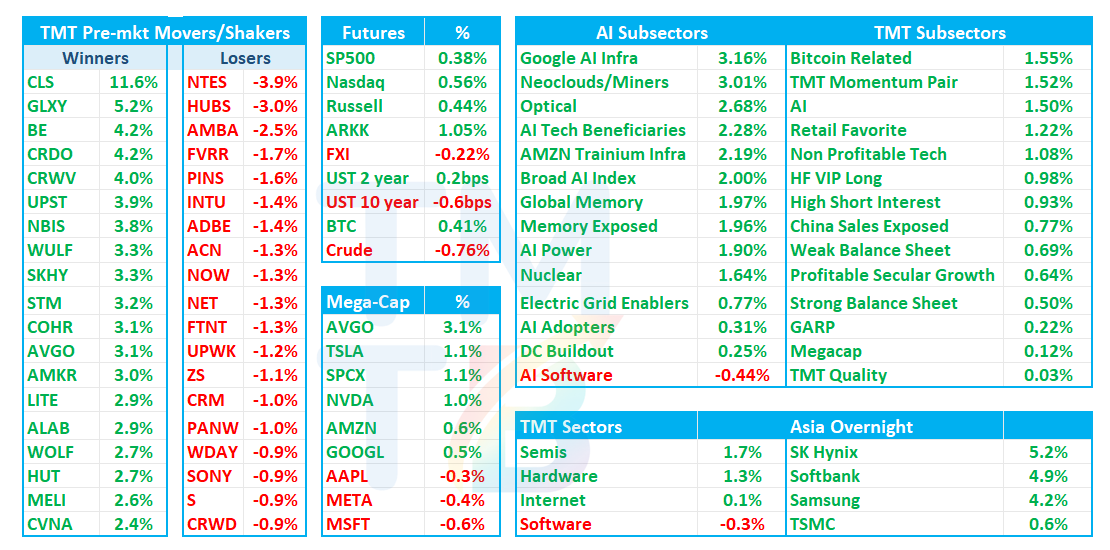
Good morning. QQQs +40bps following through on yesterday’s strength. Crude is flat while yields dip 1-2bps across the curve ahead of the Fed tomorrow.
In Tech. Semis +1.4% leading the way higher again as investors felt yesterday cleared the deck somewhat with a better received Anthropic S-1 and tea leaves pointing to a good Oct ARR #, along with positive financing news from META, AVGO, and SPCX all of which helped remove some uncertainty from the Lab ARR and funding debate. We had some thoughts on the cleaner set up for semis in our EOD Wrap yesterday. Memory names were up 4-6% in Asia. Neoclouds +3%+early. CLS +12% on a beat and raise ahead of their investor day today. AVGO +2.6% on a DA Davidson Upgrade and $63B in funding. Software -0.4% led lower by HUBS -2.5% after a UBS downgrade.
Stocks in Asia mixed despite Korea being up: TPX +0.61%, NKY +1.73%, Hang Seng -0.73%, HSCEI -0.45%, SHCOMP -1.33%, Shenzhen -2.55%, Taiwan TAIEX +0.12%, Korea KOSPI +3.09%
We’ll start with EPS recaps for CDNS, CLS, GLW, and PYPL then onto the usual (click to skip straight there)
Let’s get to it…
EARNINGS:
CDNS +2%: Looks better with Q4 Guide Well Above Street Drives a Third FY Raise; Maestro Is CDNS’s Answer to GPT-Synopsys
CDNS beat its revenue guide midpoint by $23M (vs. $14M in Q2) and raised FY26 revenue by $102M to +21% (~18% organic ex-Hexagon), with record backlog of $8.2B (+17% y/y) in a lighter renewal year. Maestro looks like a great answer to GPT Synopsys. Overall, good looking numbers with bulls focused on the better Q4 guide, but bears will push back and say AI debate still not solved, and the hoped-for 2H recurring acceleration did not come with just in line Q3 revs, weaker GM, the upside came from upfront revenue,& bookings fell y/y with cRPO flat
Upside was upfront-led (record hardware, IP +24%) while recurring grew 18%, and mgmt acknowledged customers aren’t yet paying meaningfully for agents; AI is monetizing indirectly through heavier base-tool usage. Investor focus on Maestro, a family of CDNS-post-trained open-weight models plus a model router, positioning CDNS to own the AI design interface rather than partner with a frontier lab the way SNPS did with OpenAI. Buybacks doubled to $400M with a new $2.5B authorization, though GAAP EPS missed the guide and Q3 OCF was light.
Details: Q3 revenue of $1.633B (+22% y/y) and EPS of $2.11 beat Street ($1.614B / $2.05); the Q4 guide of $1.71B / $2.22 sits ~4% / ~9% above Street, and FY26 raised a third time to $6.40B (+21%) / $8.40. Doubled buyback
Key Takeaways
Guide. The Q4 guide of $1.695–1.725B (+18.7% y/y at the midpoint) and EPS of $2.19–2.25 sits ~4% / ~9% above Street ($1.649B / $2.03), with non-GAAP OM of 44–45% vs. Street ~43.2%. FY26 revenue rose $102M at the midpoint to $6.387–6.417B (+20.9% y/y vs. Street $6.32B, +19.4%), ~4x the $23M Q3 beat, and EPS rose $0.30 to $8.40 (Street $8.15). It is the third straight raise and came in ahead of investor expectations after the big Q2 raise. The FY revenue guide now sits ~$450M above the initial $5.95B, though ~80% of that increase traces to Hexagon (~$160M) and China upside (~$200M); stripping both out leaves ~14% growth. Mgmt still called the outlook prudent and noted Q4 is usually its strongest quarter.
Recurring. Recurring revenue grew 18% y/y (79% of mix vs. 78% in Q2), down from ~24% reported in Q2, when Hexagon added ~4 pts and mgmt put normalized growth at “high teens to 20%.” The 18%-vs.-20% comparison raised on the call mixes Q3’s reported rate with Q2’s normalized one; like for like, and assuming a similar Hexagon lift, organic recurring slowed to roughly mid-teens. With 2H recurring acceleration the key pre-print focus, this is the quarter’s main blemish, and the beat came from upfront revenue (+42% y/y) instead. Mgmt tied the slowdown to China timing in the year-ago quarter (China was 18% of Q3’25 revenue) and pointed to FY25’s 11% as the better yardstick; averaging Q2 and Q3, recurring is ~21% reported and mid-to-high teens organic.
Callback. Mgmt said the raise reflected a better Q3, improved visibility and strength across the business, led by record hardware demand and IP, and that the outlook remains prudent. Despite a lighter renewal year, bookings and backlog benefited from add-ons as customers expanded usage beyond initial plans, but customers are not yet paying significantly for agents; increased use of existing tools is what is driving more license purchases. The Q3 charitable contribution was in the “tens of millions,” which implies OM would have topped the 44.5% high end of the guide without it. On AI, CDNS wants to stay model-neutral and not be tied to one provider despite discussions with OpenAI this year, arguing Maestro’s edge comes from deep integration with its EDA tools rather than the underlying model.
Backlog. Backlog hit a record $8.2B (+17% y/y) and cRPO $4.2B (+20% y/y). Both barely moved q/q (backlog +~$0.1B, cRPO flat), implying Q3 book-to-bill of only ~1.06x. YTD bookings growth slowed to ~26% from ~55% through 1H (both analyst figures mgmt didn’t dispute), implying Q3 bookings fell y/y against a strong year-ago quarter. Looking ahead, mgmt said 2027 carries a larger renewal base than 2026 and backlog should be higher y/y, but it stopped short of calling 2027 a stronger year.
AI. Active Super Agent engagements topped 100 across ChipStack, ViraStack, InnoStack and AuraStack, vs. 20+ for ChipStack and 25+ for ViraStack cited in Q2, with ~10 public endorsements this quarter (mgmt says only ~1 in 10 customers ever goes public). Proof points: MediaTek put ChipStack into production verification (50–70% better coverage), Renesas cited 34x productivity from InnoStack, Nokia 5x from AuraStack, and Honda, using the new ChipStack RTL agent, saw 24% less area and 18% less power vs. pure foundation-model code. Mgmt credits agents for driving heavier base-tool usage behind the recurring step-up from FY25’s 11%.
Maestro. CDNS launched Maestro, a portfolio of domain-specialized models (small decision models up to frontier-class open-weight models, including NVDA’s Nemotron) post-trained on CDNS tools and data, plus a router that escalates to frontier models only where they do better, expected in just ~5–10% of EDA use cases. Mgmt cites up to 30% better quality and up to 5x token efficiency vs. general-purpose models. Customers can post-train Maestro and run it on-prem or in the cloud, while CDNS keeps barring them from post-training generic models on CDNS tools. CDNS will charge for model usage on top of EDA and agent licenses, and the CFO stressed that customers can bear their own model compute and that CDNS won’t become a general-purpose AI infrastructure business. Incremental vs. Q2, when mgmt said customers were demanding LLM choice: Maestro productizes that with a CDNS-owned model layer, a clear divergence from SNPS’s OpenAI partnership (GPT-Synopsys).
Hardware. Palladium/Protium posted another record quarter with new logos and growing hardware-cloud usage, and mgmt expects a record hardware year. The change vs. Q2: then hardware was still supply-constrained; now the CFO says there are “no capacity or supply chain constraints,” with inventory up another $58M q/q to ~$449M (+$72M in Q2) to ship against a significant backlog (one report still describes demand as exceeding available capacity). Demand is very strong across several large customers, including INTC; mgmt gave no 2027 hardware outlook beyond calling design-size growth a megatrend (quote #3).
Margins. Non-GAAP OM of 44.1% was in line (Street 44.1–44.2%) but down ~350 bps y/y and 140 bps q/q, as non-GAAP G&A jumped to $81M from $54M in Q2 ($39M a year ago) on the timing of annual charitable contributions (Q3 this year vs. Q4 last year). The FY26 OM guide rose to 44.7% from 44.25%. FY26 incremental margin is only ~45% (+$1.1B revenue, +~$500M op income) because Hexagon adds little profit; ex-Hexagon, mgmt puts it in the usual 54–55% range, expects Hexagon headwinds to largely fade in 2027 (as with BETA) and targets ≥50% incremental margins. EDA and SD&A carry the highest margins, then IP, with hardware lowest. GAAP OM fell ~550 bps y/y to 26.2%, below the 27.5–28.5% guide, GAAP EPS of $1.05 missed the $1.11–1.17 guide, and roughly 60% of the non-GAAP EPS beat came from lower other expense and share count.
IP. IP grew 24% y/y to an estimated ~$237–245M vs. Street ~$235–237M (segment dollars are derived from CDNS’s rounded mix), normalizing from >40% in Q2, which mgmt had cautioned not to annualize. Drivers: AI infrastructure, custom silicon and chiplets across interface, memory and foundation IP; Tensilica had a record quarter and a space company chose CDNS IP for a custom chip program. IP is near a ~$1B run-rate, with foundry diversification (the INTC 14A deal announced in Q2, Samsung) still ramping into 2027. On royalties, mgmt noted they already exist in Tensilica and design IP but called them “just one vector,” a contrast with SNPS’s ~$1B royalty ambition.
EDA. Core EDA grew 20% y/y (18% in Q2), ahead of Street in dollars, with 16 new digital full-flow wins, including very large customers adopting the full digital flow (synthesis and signoff, not just Innovus). Displacements broadened to analog (Spectre FX at a marquee infrastructure silicon provider, multiple 2nm projects) and PCB (Allegro at a leading EV OEM), and verification was strong in big digital and memory designs at hyperscalers and memory makers.
Customers. Systems companies are now ~45% of the business, and new chip designers include space and finance companies. Q3 brought a wide-ranging expansion with a marquee systems customer and a top telco that named CDNS its primary design partner. The CEO called design activity the strongest he has seen, with analog/mixed-signal and memory recovering alongside AI, helped by physical AI.
China. China was 16% of revenue (15% in Q2, 18% a year ago; one report puts Q3 at 14%), is growing 30%+ in 2026 and is tracking ~15% of FY26 revenue vs. the 12–13% initially assumed (~$200M of upside). The guide again assumes export controls stay substantially similar.
Bull vs. Bear Debate
Bulls see CDNS as one of two toll roads on every advanced chip and system design, with ~80% recurring revenue and a product set that gets more valuable as AI raises design complexity. Design activity is the strongest mgmt has seen, and the customer base is broadening well beyond traditional semis: systems companies are now ~45% of the business, every hyperscaler is building custom silicon, and new designers range from AI startups to space and finance companies. The structural tailwinds are multi-year: chiplets and 3D-IC multiply verification and IP needs, a more diverse foundry landscape (INTC 14A, Samsung 2nm, Rapidus) requires new IP ports and DTCO work, and physical AI pulls SD&A into new markets. The moat is the middle layer of mgmt’s “three-layer cake”: signoff-accurate physics engines and silicon-correlated data that take decades to build and that foundries certify. Bulls argue agents raise the value of that layer rather than replace it, because every agent action still has to run CDNS engines to produce a design that works, and agents run far more design iterations than engineers do.
This quarter fed that thesis. FY26 growth is now 21% (~18% organic), the fastest in years, with a Q4 guide ~4% above Street and a third raise in three quarters. Recurring growth of 18% is still well above FY25’s 11%, and mgmt attributes the step-up to agents driving more base-tool usage, which is the bull mechanism at work. Super Agent engagements topped 100 with measured gains at Renesas, MediaTek, Nokia and Honda, and Maestro gives CDNS a credible answer to the frontier labs: own the model layer, route among third-party models and keep the customer interface. Hardware is no longer supply-constrained, so record demand can convert into shipments. Estimates can move higher on several levers: 2027 is a heavier renewal year in which agent and model value can be priced into larger multi-year deals; Hexagon integration should lift incremental margins back to the usual 54–55% or better; IP should pass a $1B run-rate on foundry diversification; and buybacks of more than 50% of FCF shrink the share count. Clear evidence of direct agent or Maestro monetization would let the multiple re-rate toward the high 40s P/E range CDNS held for most of the past five years.
Bears argue AI is the first real threat to EDA’s business model in decades, and that the best of this cycle is already in the numbers. The structural worry is that agents and frontier models become the designer’s front end, where design intent and workflow live, and push EDA engines toward commoditized back-end services priced on usage. AI could also raise engineer productivity enough that customers need fewer licenses per design, while frontier labs, hyperscalers and customers’ own agents capture the value of the new layer. CDNS still discloses no agent revenue, and mgmt concedes customers are not yet paying significantly for agents, so the AI upside remains a promise. Customers are already scrutinizing token budgets, and startups are going after the agent layer too (NVDA also works with ChipAgents). Meanwhile SNPS has laid out explicit long-term targets and a royalty model, and CDNS declined to offer a framework of its own. The cyclical worry is that 2026 benefits from things that may not repeat: ~80% of the ~$450M raise since the initial guide traces to Hexagon and China upside, two record hardware years leave a tough comp, China is growing 30%+ under an export-control regime that can change at any time, and IP is lumpy by nature.
This quarter gave bears several data points. Recurring revenue, the cleanest read on AI-driven software consumption, slowed to 18% from ~24% in Q2 (roughly mid-teens organic) just as bulls were looking for 2H acceleration; the beat came instead from upfront hardware and IP, the lumpier part of the model. Q3 bookings fell y/y (book-to-bill ~1.06x), cRPO was flat q/q, OCF missed Street by ~25% on receivables and inventory, GAAP EPS missed its own guide, non-GAAP OM fell 350 bps y/y, and roughly 60% of the non-GAAP EPS beat came from below the line. Maestro also brings new costs: post-training models, running a router and possibly giving away model value to win the interface. Estimates and the multiple could compress on a hardware digestion year in 2027, tighter China export rules (16% of revenue), weaker renewal pricing if customers refuse to pay for agents, a slower Hexagon payback, or evidence that agents reduce seat counts. If investors conclude EDA is a middle-layer utility rather than the owner of the AI design workflow, the multiple would drift toward mature-software levels.
CLS +16%: Clean beat and raise. $40B FY27 Guide (+90%) Clears street by ~11% and 2028 Higher at $21.50
Looks better against very low expectations as stock had been down 30% into the print and 5% yesterday. Bulls will point to the FY27/28 raise which helps answer TPU share loss debate while networking also re-accelerated. Bears will nitpick on GM slight miss and concentration moving wrong way. Investor day today.
Q3 beat on revenue, OM and EPS, Q4 guide in line, FY26 raised to $21.0B/$11.55, and an initial FY27 guide of $40B/9.0% OM/$21.50 EPS well above Street, but buyside still expecting someting closer to $25 for the full year
Revenue: $5.83B, +83% y/y (last q +62% y/y) vs. Street ~$5.45B, +~71%
EPS: $3.30 vs. Street ~$2.96
Non-GAAP OM: 8.5% (record) vs. Street 8.4%
FY27 Guide: revenue $40.0B, +90% vs. Street ~$35.9B, +~74%; EPS $21.50 vs. Street ~$19.80
Growth accelerated from +69% to +90% on a $21B base, OM expanded another 60bps to a record 9.0%, and mgmt says 2028 customer demand forecasts are “meaningfully higher” than the $40B outlook. The top customer (believed to be GOOGL) also grew ~35% q/q, which undercuts the TPU push-out and share-loss worries that, along with a weak AI tape, took the stock down ~33% in the month into the print. The blemishes are mix and cash: adj. GM slipped to 11.2%, below the mid-11s mgmt talked to last quarter, and FY26 FCF was cut to $460M from $600M (one quarter after being raised) to fund 2027 working capital, with $1.5–2.0B of FY27 capex on top. The stock is up ~16% AH to ~13x the FY27 EPS guide, and today’s Investor Day needs to size 2028 and the cash path.
GLW +2% pre: Beat above the top of the guide, carried by Optical ($2.38B, +44% y/y vs. ~$2.25B Street); 4Q guide in line on revenue, better on EPS. No change to the Springboard targets in the release.
Solid quarter overall. Stock is ~19% lower than a month ago and about half off its late-June high, so the setup was more about Optical upside than a target raise. Up ~2% pre, a bit behind optical peers (LITE/COHR +3%).
Sept-Q core sales of $5.08B (+19% y/y, the fastest since Springboard launched) cleared the top of the $4.9–5.0B guide vs. $5.03B Street and in line with bogeys. Core GM of 40.5% was 30bps above Street (+150bps y/y), and core EPS was $0.91 vs. $0.89 Street and the $0.85–0.89 guide.
Optical drove beat: +15% q/q, with Enterprise +84% and Gen AI sales more than doubling. That’s ~$130M of upside on a ~$50M total beat, so the rest of the portfolio was ~$80M light. Glass Innovations fell 3% y/y as memory pricing weighs on TV/PC/phone units. Solar was flat q/q and still losing money, with the ramp slower than planned (in July they said Solar profitability would improve in 3Q; it didn’t).
4Q guide is $5.2–5.3B vs. $5.20B Street, and EPS $0.96–1.00 vs. $0.93 Street. The midpoint is right at the ~19% pace on a slightly easier comp, and +3% q/q is normal seasonality, so the upside is mostly EPS. Some previews had revenue closer to $5.3B.
Q3 annualizes to ~$20.3B, so the end-2026 $20B Springboard run rate is already in hand a quarter early (4Q guide ~$21B). Four new multibillion-dollar LTAs incl. Verizon and AT&T add carriers to the AMZN/NVDA deals from 2Q.
Call ongoing…looking for any lift to the 2028/2030 Springboard targets (the debate coming in), Solar ramp timing, and how much Optical capacity comes on in 2027.
PYPL -1%: Big EPS beat and FY raise (~$5.60 from ~$5.38), but cost and credit drove beat; branded checkout +1%, the low end of the talked-down 1–2%, and revenue light. Nothing on strategic alternatives in the release.
Mixed bag. Better P&L, but branded weaker Stock is ~11% below where it was before Stripe/Advent walked away in late Aug, so most of the deal premium is already out; a little lower pre.
3Q non-GAAP EPS was $1.45 (+8% y/y) vs. ~$1.32 Street and a guide for a low-single-digit decline. TM$ of $3.95B grew +2% (+3% ex-interest) vs. a “slightly positive” guide. Revenue of $8.58B (+1% FXN) was light vs. $8.71B Street.
Pushback is quality: transaction + credit losses fell ~$97M y/y (incl. a reserve release tied to selling more receivables), more than the entire $79M of TM$ growth. Non-transaction opex grew just +1%, and FY opex growth is now guided to mid-single digits from 7–8%.
Branded checkout +1% FXN (2Q +2%, 3Q’25 +5%), with EU tariff pressure offsetting US improvement. PSP slowed to +8% from +13%; Venmo held +14%. Transaction take rate -6bps.
On the raise, ~$0.14 of the $0.22 is the 3Q beat vs. guide, the rest is 4Q. 4Q TM$ “slightly positive” is a decel from +2% even on an easier comp (4Q’25 +3% vs. 3Q’25 +6%), so the 2-yr stack drops ~5pts.
For the call: any update on M&A / strategic alternatives, branded checkout exit rate into holiday, and 2027 framing, since most of the turnaround levers don’t hit until then.
Details:
3Q Non-GAAP EPS: $1.45 (+8% y/y) vs. Street ~$1.32 and guide LSD decline (3Q’25 $1.34)
3Q Revenue: $8.58B (+2%, +1% FXN) vs. Street $8.71B
3Q TM$: $3.95B (+2%; +3% ex-interest) vs. guide “slightly positive”
3Q Branded Checkout TPV: +1% FXN vs. talked-down 1–2% (2Q +2%, 3Q’25 +5%)
3Q TPV: $487.1B (+7% FXN) vs. Street ~$491B; Venmo $96.8B (+14%) vs. Street ~$95.3B; PSP +8% (2Q +13%)
3Q Transaction + Credit Losses: $386M vs. $483M a year ago
3Q Non-GAAP OM: 18.8% (+16bps y/y)
4Q Guide: TM$ slightly positive (on a +3% comp); non-GAAP EPS ~$1.43 (4Q’25 $1.23)
FY26 Guide: non-GAAP EPS ~$5.60 vs. prior ~$5.38; TM$ ~$15.7B vs. ~$15.6B; non-transaction opex MSD growth vs. 7–8%; adj. FCF $6.5B+ vs. $6B+; buyback $6B
Capital Return: $1.5B buyback in 3Q (~28M shares); TTM $6.0B, weighted shares -11%
TECH RESEARCH/NEWS
Let’s start with AVGO…
AVGO / Anthropic: $63B chip financing package announced – Broadcom
Bank of America, Blackstone, Citi and Morgan Stanley announced a $63B financing structure for an SPV to buy Broadcom AI accelerators and networking equipment for lease to Anthropic, with deliveries scheduled for 2027. Banks are arranging first-lien financing; Blackstone is the sole committed second-lien provider. The announcement formalizes funding for another large block of AI compute.