


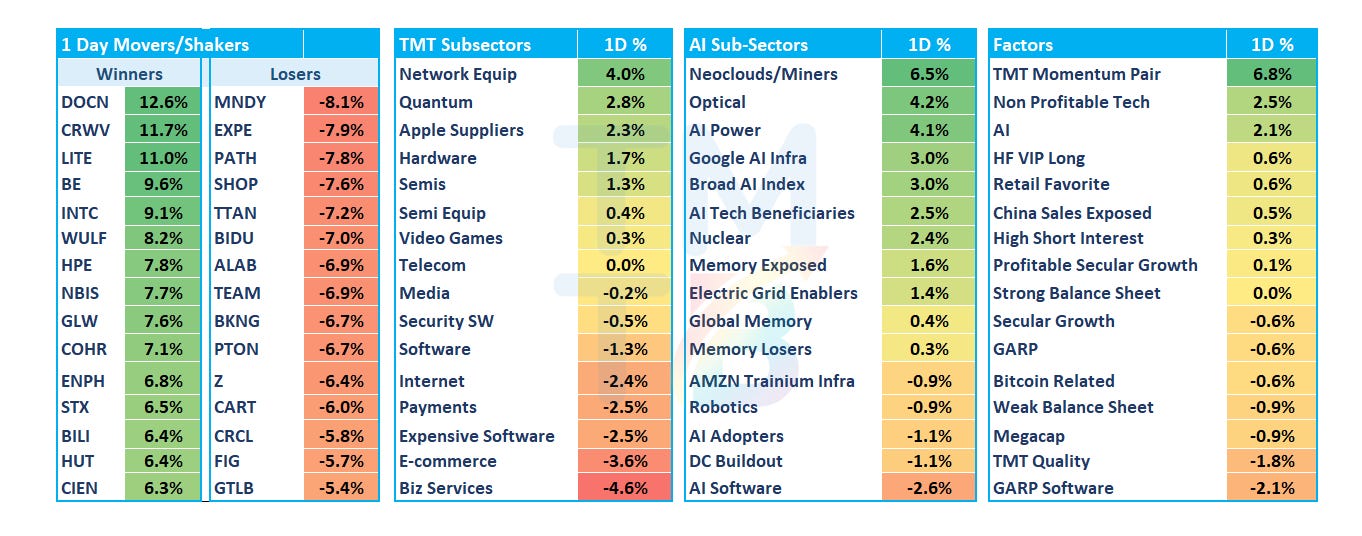
Good afternoon. QQQs -8bps, while SOX +1.3% led on the first trading day after Labor Day. TMT Mo +7%. Why the semis outperformance? Several things are lining up: positioning has reset, semi charts started looking better late last week, and investors are back at their desks looking for places to put gross back on. Better charts, cleaner positioning and a fuller catalyst calendar in Sept starting with the conferences today giving some a reason to start with semis.
Astra also picked up plenty of hype over the weekend, although the early consensus is that it’s not yet a broad step-function improvement over Fable 5.1 outside 3D modeling, spatial reasoning and a handful of other use cases. More importantly, investors seem more comfortable with the September path given the lineup and cadence of model releases leading into OAI’s DevDay on September 29 (Grok 4.7, Fable 5.1, META’s Watermelon, etc.). Alongside that, we’re seeing more concrete applications of these models through Grok Bot for workplace tasks and Instinct on the consumer side, with META’s newly launched Muse adding another entrant today. The bullish semi read-through is that you don’t necessarily need a step function in intelligence if better harnesses make that intelligence useful for a much wider range of tasks, which might provide the elusive next great use case after coding that semi bulls have been hoping to see.
The flip side is that the same setup has sw and internet investors more nervous than they’ve been in several months. We’re already seeing Instinct and broader consumer-agent fears spill into internet today, with SHOP -7%, DASH -6%, CART -5%, EXPE/BKNG -8% among others. The concern isn’t that people stop shopping, ordering food or booking trips. It’s that an agent increasingly owns the starting point, compares the options and routes the transaction, potentially weakening incumbent customer relationship & pricing power. Still many questions rather than answers here (eg, the flip side is agents could also bring incumbents incremental volume and lower acquisition costs) but as we saw earlier this year with Claude Code and similar agentic fears, sometimes it’s shoot first ask later in Tech land. Lots of good discussion around agentic read-throughs in this thread here in TMTB Slack.
Busy day today with a full lineup at GS and Citi TMT conferences. We’ve included some quick snippets below on a lot of names, and we posted fuller recaps from the key presentations in TMTB Slack in the new channel #conference-key-quotes. We sent out OpenAI CFO Sarah Friar recap earlier here. Not surprising to anyone, most AI companies sounded good.
Let’s get to it…
Let’s get to the good stuff…
AI/SEMIS
INTC +9% as Northland upgraded to Buy and Digitimes had an article calling out another 10% CPU price increase.
AMD +6% getting a nice bid from Computer Use read-through to CPUs (you need more of them) and CFO and CEO were at Citi sounding confident on the MI450/Helios ramp despite the execution chatter, saying 2027 demand and volume are now running above AMD’s original plan, all three anchor customers (Meta, OpenAI, Anthropic) are forecasting more than AMD expected, and supply, not demand, is the constraint. The new items were margin commentary (gross margin in Q4 and through 2027 slightly below Q3’s 56% guide as MI450 ramps, offset by server CPU and embedded mix), a stance that wafer-cost increases get passed through but AMD will not raise prices just to expand margin, and optics detail for the 2H27 accelerator (scale-up domains above 72, copper and near-package optics side by side, not a binary shift). Data center doubling next year, server CPU up 80%-plus in 2H and 70%-plus in 2027, and the $220bn 2030 CPU TAM were all repeats from the Aug 4 earnings call and the Aug 11 KeyBanc forum.
Optical (LITE +11% / COHR +7%) — Getting the bid off AMD at Citi TMT: the company plans to offer both copper-based and near-package optical connectivity for larger scale-up domains on the 2H27 accelerator, with copper and optical likely coexisting for multiple generations rather than transitioning through a single industry-wide shift. This is the first dated roadmap from a merchant GPU vendor putting optics inside the scale-up domain (where bandwidth per GPU is a multiple of scale-out) rather than just at the switch. It's the customer-side confirmation of what LITE's CEO said last week, that the next 12–18 months are pivotal for optics adoption inside server trays, and it comes on top of AWS bankrolling 1.6T optical connectivity with QCOM.
AVGO +3.0% as CEO Hock Tan defended the $115bn/$230bn AI revenue path at Goldman and said the binding constraint is power-ready sites rather than silicon, which Broadcom can lock in for 2027. His value framework was the news: one gigawatt generates about $30bn of ARR for a top frontier model against roughly $10bn of running cost, and his token math has roughly $200bn a year of global inference cost against $150bn of model revenue, with frontier models earning at least 75% of the revenue on half the tokens while open-weight players spend about $100bn to earn $30bn, so value goes to where intelligence keeps improving and second best gets nothing. He pushed back on the circularity critique of the Apollo/Blackstone platform (using financing to create demand, not circular), sketched a die roadmap from two dies to four to eight, and previewed a December capital-return decision with record cash, mid-40s free-cash-flow margins next year, and a dividend increase plus buyback as the realistic options.
BE +9% after getting added to SP500
AMAT +4.0% as CFO Brice Hill at Citi said every indicator still points up: the rolling eight-quarter forecast from its largest customers has risen every quarter this year, the fab tracker now covers more than 100 factories, leading-edge logic and DRAM sit near 100% utilization, and the ramp is gated by clean-room construction rather than demand. The incremental piece was the DRAM greenfield math, 300-400K wafer starts a month added in each of the next several years at roughly $10bn of equipment per 100K starts versus about a quarter of that for an upgrade, which is why he calls this a much larger investment cycle. He also called HBM de-speccing neutral for equipment demand, since customers are shipping more systems per memory chip, not fewer.
QCOM +3% after inking a multi-generation deal with AWS to co-develop custom AI inference silicon and 1.6T optical connectivity (leaning on its SerDes/optical DSP IP), and issued Amazon warrants for 25M shares at $161.26, ~$4B all-in. Warrants expire Sept 3, 2036 and vest in tranches tied to commercial milestones, including up to $60B of Qualcomm server chip/tech purchases so it’s a performance-gated stake, not a $4B cash injection. Second hyperscaler anchor after Meta…CFO Akash Palkhiwala was at GS walking investors through the morning's Amazon deal, calling it the execution proof point investors wanted, said it makes the roughly $5bn FY27 data-center target very high confidence, and that the undisclosed second hyperscaler is similarly proceeding, with a path to $15bn in FY29. Elsewhere the CPU TAM has tripled to over $200bn with half moving to Arm, low-end handsets are down low-teens on memory costs while premium is unaffected, and the $10bn auto target was pulled forward again.
ALAB -7% — Read-through was negative from QCOM/AWS deal: Amazon their biggest customer and QCOM deal targets internal networking bottlenecks with co-developed optical connectivity up to 1.6T, using Qualcomm’s SerDes and optical DSP tech, which is squarely in ALAB’s signal-conditioning/interconnect lane (Aries, Taurus, Scorpio). Amazon already holds ALAB warrants contingent on product purchases reaching $6.5B, but QCOM inking a a parallel $60B warrant had some investors worrying it will lead to some share loss.
SNDK -0.1% as CFO Luis Visoso told Citi the new business models now cover 50% of bits this fiscal year and two-thirds in fiscal 2028 with roughly 80% gross margin at the floor, and two contracts have already been reopened by customers wanting more volume and longer duration. Supply growth is 100% node-driven with no wafer additions, industry bit growth stays mid-to-high teens, and his line was that there cannot be more demand than supply by definition. The incremental bit was that the KV-cache demand model behind High-Bandwidth Flash has gone up in every recent revision, with products in customers’ hands in 2027; $4.5bn of last quarter’s $5bn free cash flow went to buybacks.
ANET +0.6% as CTO Ken Duda and CFO Chantelle Breithaupt explained the anatomy of the guide raise at Goldman: supply-chain work plus two quarters of PO visibility by August, and the near-tripled $9.7bn of purchase commitments is a demand signal, not inflation. Scale-across is about 30% of this year’s $3.5bn AI target because customers cannot get enough power in one place, scale-up is white space where ANET has almost no share with ramp in late 2027 and volume in early 2028, and the price increase was curated to memory-heavy bills of material on future POs only, meant to be margin-neutral. On neoclouds, the CFO’s rule is prepayment or walk away, since not all of them make it.
VRT +3.7% as CEO Gio Albertazzi told Goldman the market is strong and if anything strengthening, with pipelines building, sales cycles accelerating, and demand broadening beyond the US as frontier labs become hyperscalers, while the supply congestion flagged at Q2 is specific to the OneCore and SmartRun converged products. On 800-volt he gave timing: sidecar acceleration from 2H27, native powertrains commercial late 2027 with volumes in 2028, and Vertiv will field the whole range including a solid-state transformer because a one-trick pony would starve. The Utility Innovation Group acquisition puts Vertiv in the behind-the-meter power conversation, and hyperscalers doing their own power and cooling is decade-old behavior where the door never closes.
INTERNET
RBLX +3.5% the standout after better weekend data and positive read-through from Astra’s capabilities to make cheaper and better games (ie, RBLX wins from its distribution)
Instinct losers: DASH -6%; SHOP -7.5%; CART -6%
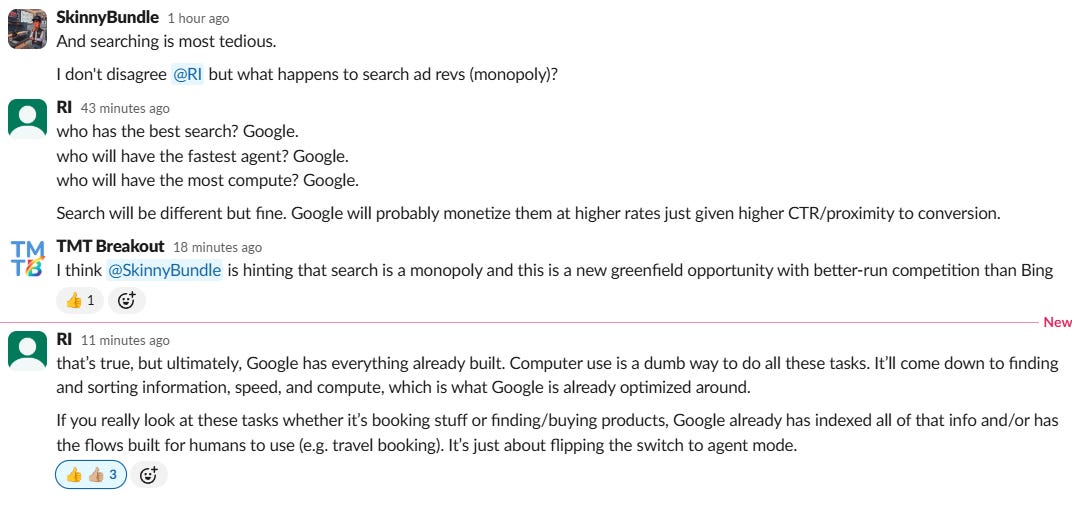
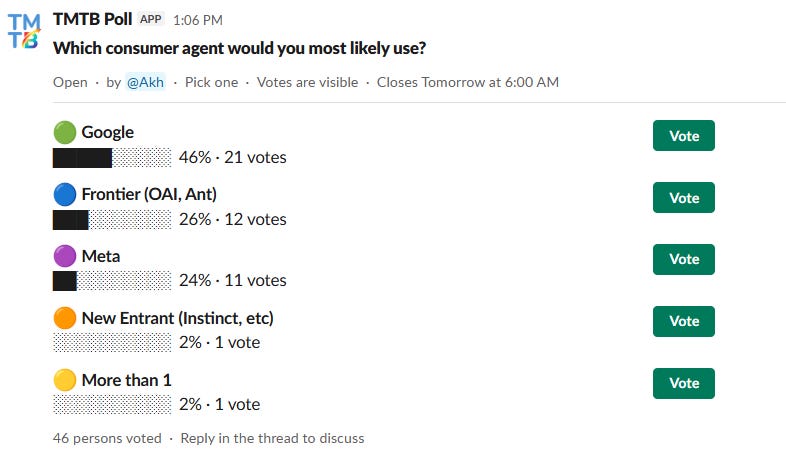
GOOGL flat. Some good back and forth in Slack on where there roll is in the agentic world:
Cloud CEO Thomas Kurian was also at GS saying cloud is winning new customers about twice as fast as a year ago with $100m-plus deals up 2x, 17 product lines each above $1bn, and customers typically spending 50% more than they commit. The silicon claims were the incremental part: the TPU business is more than twice the next largest hyperscaler’s, AI-server payback is under two years and half that on Google’s own chips, the majority of infrastructure contract value sits in five-year contracts, and TPUs now sell three ways, including outright purchase for customers’ own data centers and a neocloud set up with Blackstone. Gemini Enterprise is in over 90% of the Fortune 100 and AI attach across Cloud customers is 80%.