


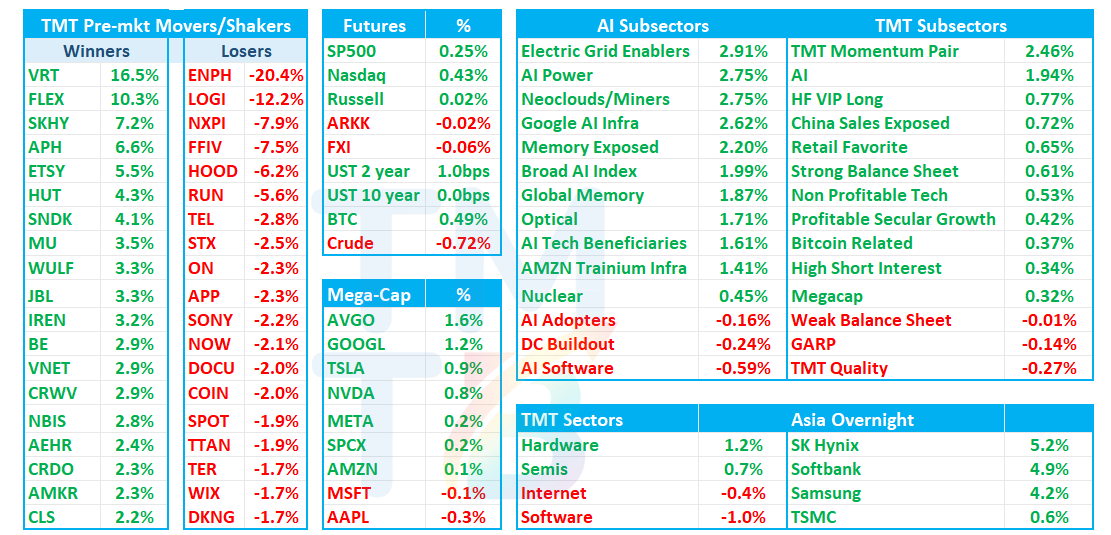
Good morning. QQQs +40bps as FOMC later today where market is expecting a hold. Yields flattish while Oil -1%.
In Tech, Semis +1% continuing to rally on the back of Korea’s KOSPI’s 7% gain. Overall, earnings mixed overnight in the space with SKHY, VRT, GEV, FLEX, APH all betterand STX, NXPI, TER, FFIV mixed. SNDK/MU +4% on the back of Hynix’s solid print that came above buyside bogeys on both #s and capital return (Kioxia +14% /Samsung +4% overnight). Software -1% with NOW -2% leading the way lower ahead of their print tonight (Bernstein put a damper on bulls hopes for a big cRPO print yesterday calling out a 80-100bps headwind from a VA contract renewal).
Asia mainly up: TPX -0.14%, NKY +1.08%, Hang Seng +0.23%, HSCEI +0.32%, SHCOMP +0.91%, Shenzhen +1.98%, Taiwan TAIEX +2.04%, Korea KOSPI +6.63%
Another busy day in Tech today was we get ORCL’s analyst day near noon, MNDY analyst day at 2pm, AAPL product event at 1pm, and Fed at 2pm. Then after-hours, we get MSFT, GOOGL, NOW, EBAY, CVNA, FTNT, and others…
Lots to get to today. We’ll hit earnings first: SKHY, STX, NXPI, VRT, GEV ETSY then onto the usual. (Click link to go straight to the relevant section)
Let’s get to it…
SKHY +7%: ASP-Driven Beat, Mid-20s 4Q Bit Guide, “Sold Out Through 2029” and a FY26 KRW100T Capital (10% of mkt cap) Return Working to take on the the Peak-Cycle Bear Case
Overall, looks really solid across the board with revs and OP beating street and bogeys and better capital return plan. 3Q revenue of KRW104.6T (+32% q/q, +328% y/y) and OP of KRW83.3T (~80% OPM, a record) beat Street by mid-to-high single digits on a high-20s% DRAM ASP lift; EPS missed on KRW32.6T of non-operating FX and investment losses. Bogeys were around KRW 102-103T for revs and mid to high 70s for OP so this is much better.
The beat was all price (DRAM ASP +high-20s%, NAND +mid-20s% vs. models in the mid-teens to low-20s%), but the bigger number is 4Q: a +mid-20s% q/q DRAM bit guide that puts 4Q revenue/OP ~10-20% above pre-print Street.
Mgmt sounded good on the call: LTAs now cover >50% of ‘27/’28 capacity across 14 customers (in July mgmt wouldn’t size coverage), DRAM/HBM is “effectively sold out” through 2029, and 2027 HBM volume and price are locked, with the HBM-vs-commodity margin gap set to narrow “meaningfully.”
FY26 shareholder return of ~KRW100T (~US$75B, ~10% of mkt cap) topped the buyside bogey. Local shares closed +~11% but still sit ~50% below June highs at ~2-3x ‘27 EPS. Should help with memory sentiment especially as semi investors have looked to put new $ to work this week and with analog/HDDs not looking as good after NXPI/STX. MU +4% / SNDK +5% / Kioxia +12%
Key Takeaways
LTAs. The most incremental disclosure. In July, mgmt said it couldn’t say how much of sales LTAs would cover; now it’s 14 key customers (vs. ~10 last q) incl. major global CSPs, covering >50% of 2027 and 2028 capacity, with similar coverage targeted over the medium-to-long term. Five-year terms and deposits were flagged in July; new are the coverage, the customer count, extension talks with some customers and a more specific pricing structure (floats with market conditions inside a price range agreed with each customer). Adding volumes under discussion based on customers’ concrete purchase plans, DRAM and HBM are “effectively sold out” through 2029. Non-LTA capacity is deliberately kept open for spot upside and next-gen products.
Capital Return. FY26 return of ~KRW100T: ≥KRW30T of dividends and ≥KRW60T of buybacks, incl. August’s KRW40T program (completed last week, to be cancelled). That’s FY26 alone, not a multi-year figure, despite some headlines. 3Q: KRW20K DPS (KRW10K regular + KRW10K Kioxia special) = KRW14T, plus KRW20T of share purchases, half cancelled and half for exec/employee comp (excluded from the KRW100T). That implies ~KRW35T more in 4Q, incl. the rest of the Kioxia special in the year-end dividend. The bogey was ~KRW30T on top of August’s KRW40T (Korean press had floated KRW50-60T). Buybacks continue quarterly, sized on price and valuation, and mgmt said outright the shares are undervalued. Framed as delivering on the >50%-of-FCF commitment; no framework yet beyond FY26. Solidigm’s IPO review was dropped given market volatility.
HBM. 2027 HBM volume and pricing are finalized with major customers and reflect HBM4’s higher value. Mgmt expects the HBM-vs-conventional DRAM profitability gap to “narrow meaningfully” (i.e., HBM currently earns less than commodity DRAM after this year’s spike) and HBM revenue and profit to rise significantly in 2027. Updated models have blended HBM ASPs +~55-60% next year (HBM4 at the main customer ~US$3.3/Gb vs. ~US$2.1 today). Execution: HBM4 entered full-scale MP in 3Q and passes HBM3E in bits and revenue in 4Q; HBM4 yield beat plan (target raised) and HBM3E cleared its mature-yield target; M15X is pulled in to full capacity by YE; HBM4E sampled in 2Q, with custom HBM projects underway. Incremental context: a key bear argument behind SKHY’s recent underperformance vs. MU/Samsung was that its Rubin HBM4 allocation would shift to Samsung on pin speed. NVDA relaxing the Rubin spec (to ~10.6Gbps from 11.7Gbps per one report; chatter says lower), plus today’s yield commentary and a locked 2027 book, help defuse it.
Stack Count. Mgmt framed customers moving to lower stacks (e.g., 12-high HBM4 to 8-high HBM4E) as a symptom of shortage, not a demand negative: customers want more cubes from constrained supply, higher per-die density offsets much of the bit impact, more cubes means more base dies and back-end work, and customer requirements remain >2x what SKHY can supply. HBM shipment plans are unchanged, and HBM profitability should stay far above prior-cycle peaks.
Pricing. DRAM ASP +high-20s% q/q (vs. ~+30% last q) on conventional DRAM strength and a richer HBM4 mix; NAND ASP +mid-20s% (vs. +mid-50s% last q) on broad increases and eSSD mix. Both beat models (mid-teens to low-20s%) despite a stronger won. Server DDR5 shipments rose 40%+ q/q, and server is ~55% of DRAM revenue by one estimate. Increases are decelerating, NAND especially, but off a base where server DRAM prices are up ~200% YTD.
AI Demand. More data-driven than July’s “solid beyond next year” framing: hyperscaler cloud revenue +30-80% y/y, cloud backlogs 2-5x y/y, paying users rising; 2027 global CSP capex +60%+ with secured power +100%+ (third-party estimates); AI DC infrastructure ~40% CAGR through 2030. New argument: the buyer base is broadening (enterprise, sovereign, on-prem), so one buyer’s pause gets backfilled by others. PC/smartphone units will fall on memory costs and shortages, more than offset by AI. Supply stays short of demand through 2030.
Supply. 2027 capex will rise “significantly” (leading-edge mix, Yongin Fab 1 ramp, domestic and overseas infrastructure) vs. a ≥KRW40T 2026 plan (~KRW31T spent through 3Q). The oversupply pushback got more specific than July’s “phased ramp” language: more fabs ≠ more bits (HBM and process complexity eat resources; shrinks yield fewer bits), Yongin/M17 shells accelerated but cleanrooms opened in phases with tool move-ins tied to demand, and, new, SKHY vets customers’ financial health and funding capacity before committing capacity, a clear nod to the neocloud-financing worry. On tech, SKHY will stretch 6F² via EUV scaling before moving to 4F² or 3D DRAM (CXMT recently touted 4F² progress).
NAND. Bits slipped slightly vs. a +LSD% guide as SKHY prioritized 321L TLC eSSD; ASP +mid-20s%. 4Q bits +MSD% as 321L passes 50% of domestic capacity. KV-cache tiering is the new eSSD driver (SALT-KV software and CXL-based CMM-Hybrid), with HBF longer term.
Below the Line. The EPS miss is entirely non-operating: a KRW32.6T net non-op loss incl. a KRW11.6T FX loss (strong won) and KRW22.9T of investment valuation losses, partly reversing 2Q’s large investment gains. Net income KRW39.8T (38% margin). The Street will look through it, but reported EPS will stay noisy.
Bull vs. Bear Debate
Bulls argue more broadly that memory is no longer a classic commodity cycle but a capacity-constrained input to AI infrastructure. Agentic and long-context inference raise memory intensity at every tier at once: HBM on accelerators, server DDR5 and SOCAMM on CPU head nodes, and eSSD for KV-cache offload. Supply can’t respond quickly: HBM consumes roughly 3x the wafer per bit of standard DRAM, shrinks now deliver fewer bits per node, cleanrooms take two-plus years to build, and little non-China NAND capacity is being added. SKHY is the purest way to own it: the HBM share leader with the highest AI revenue exposure of the big three (~70% by one estimate), first-supplier status at the key accelerator customer and industry-leading yields. The LTAs are what bulls think the market still underprices: 14 customers, five-year terms, deposits and pricing that floats inside agreed ranges, covering more than half of 2027-28 capacity. That moves SKHY from a spot-priced commodity toward contracted infrastructure revenue and should shrink the peak-earnings discount over time, the way take-or-pay structures support higher multiples in other capital-intensive industries.
This quarter delivered most of what bulls needed. The beat came from price, and the +mid-20s% 4Q bit guide puts 4Q roughly 10-20% above pre-print Street before any further price increases. The 2027 HBM negotiation, the biggest swing factor in ‘27 numbers, is closed and reprices HBM up toward commodity profitability, which is why updated ‘27 OP models coming out ~5-25% above Street and buyside #s moving up, but a bit less. The HBM4 overhang behind October’s underperformance looks resolved: yields beat plan, HBM4 crosses over in 4Q, NVDA relaxed the Rubin spec and SKHY’s 2027 allocation is locked. Capital return beat the bogey, with mgmt calling the stock undervalued and committing to quarterly buybacks. From here, estimates can keep rising if 1H27 contract prices keep climbing, LTA extensions push visibility out further and KV-cache demand turns NAND into a second AI leg. The multiple can expand as LTAs prove sticky through a pricing plateau: ‘27-‘28 FCF equals roughly half to two-thirds of today’s market cap, and at a >50% payout SKHY could retire ~20-30% of its share count by 2028 at ~2-3x earnings, while MU and SNDK trade at ~5-6x CY27.
Bears argue more broadly nothing about this cycle repeals memory’s basic economics: record margins pull in supply, and memory stocks peak when margins peak, not when earnings do. SKHY’s 85.7% GM is ~20pts above the prior-cycle record, DRAM pricing has roughly tripled this year, and the capacity response is now visible: SKHY’s 2027 capex goes up significantly, Yongin Fab 1 ramps in 2027 with M17 behind it, Samsung is executing better after its leadership reset, and CXMT keeps adding capacity while touting 4F². Some channel checks already put DRAM supply growth well above mgmt’s mid-20s demand framework. The “AI is different” argument also requires AI capex to keep compounding off an enormous base while memory becomes one of the largest line items in the AI bill of materials (industry memory revenue approaching ~US$1.7T in 2027), which invites pushback. The marginal buyer is the weakest one: neoclouds, roughly a fifth of AI data-center capex by some estimates, depend on increasingly expensive external funding, and the first place a capex pause shows up is non-LTA, spot-priced bits. Bears also think LTAs protect volume more than price: pricing floats with market conditions inside ranges whose floors aren’t disclosed, and customers will push to renegotiate if spot falls well below contract.
This quarter gave bears plenty to point to. Price growth is decelerating (DRAM from ~+30% to +high-20s%, NAND from +mid-50s% to +mid-20s%), and most expect DRAM pricing slowing to ~+7-15% in 4Q and to low-single digits by 2H27, so the earnings engine is shifting from price to bits just as SKHY adds +mid-20s% bits in one quarter. Customers are economizing: stack-count cuts, a relaxed Rubin spec and falling PC/smartphone units are all signs of price elasticity, whatever mgmt calls them. “Sold out through 2029” leans partly on volumes still under discussion, and there’s no return framework beyond FY26. Earnings quality is noisier than the OP line suggests: EPS missed by ~35% on KRW32.6T of FX and investment marks, the Solidigm IPO was pulled into a weak tape, 3Q diluted shares actually rose as July’s ADR raise outweighed buybacks, and another KRW10T of stock was bought for employee comp outside the KRW100T. HBM’s share of revenue has also retreated as commodity DRAM outpaced total top line, so more of SKHY’s earnings ride on commodity DRAM pricing than the “HBM moat” narrative implies.
STX - 2.5%: Beat Street but came up short of the buyside bar on every line, and the Dec guide ($4.8B / $9.20 EPS) is well above Street but below the ~$4.9–5.05B / $10–10.50 bogeys. Exabytes flat q/q. Tough for a still somewhat crowded long following WDC’s better print. Holding capex at 4-6%.
What a tale of two semis tapes: WDC crushes #s last week and is down same amount as STX this morning on a print that wasn’t as good, although STX held capex while one of the pushbacks against WDC was rising capex intensity for the next couple of years (STX mgmt must have been watching the px action AH on WDC’s print). For context, WDC guided Dec revenue ~12% and EPS ~21% above Street; STX is ~7% and ~8% above.