


Happy Sunday! Quite a week: QQQs finished down less than 1%, but pain underneath the surface was palpable. TMT Momentum -8%; Semis -3.2% while Software ripped +6%, led by heavily shorted AI loser basket (MNDY/HUBS/FIG all 15%+):
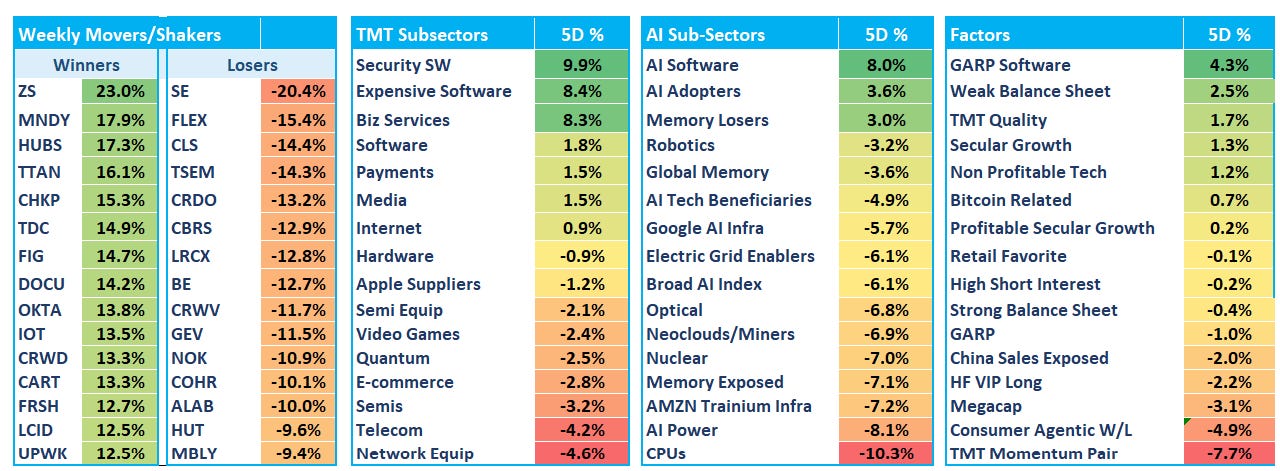
Rough week for many L/S funds this week with GS’ HF VIP basket now down 10%+ YTD and had its worst move down since 2011 on Thursday. I’m hearing MS/GS primes has the average TMT fund down anywhere from 6-8% this month. Tech net selling over Oct 5-16 ran at more than 3 std deviations, the biggest reading on GS’s chart going back to 2017. Tech is still 23.5% of Goldman’s prime book, 90th percentile of five years. MS has said semi exposure has come down to 35% from 48%.
This dovetails with the conversations we’ve had over the past couple of weeks: plenty of exposure in AI semis despite de-grossing, but there’s a buyer’s strike. Faster-money semi guys have lowered exposure, but many of the longer-term guys I talk to still feel “stuck.” That vibes with our own trading: we’ve been very slow to move our feet in our long-term book and have taken a nasty drawdown from June peaks, but the charts got us out in time before much damage in our ST/MT books in this recent pullback. Meanwhile, a lot of the Tech generalists (both fast-money and longer-term) I speak to are spending more time hunting in software.
Mag7 Exposure near highs:


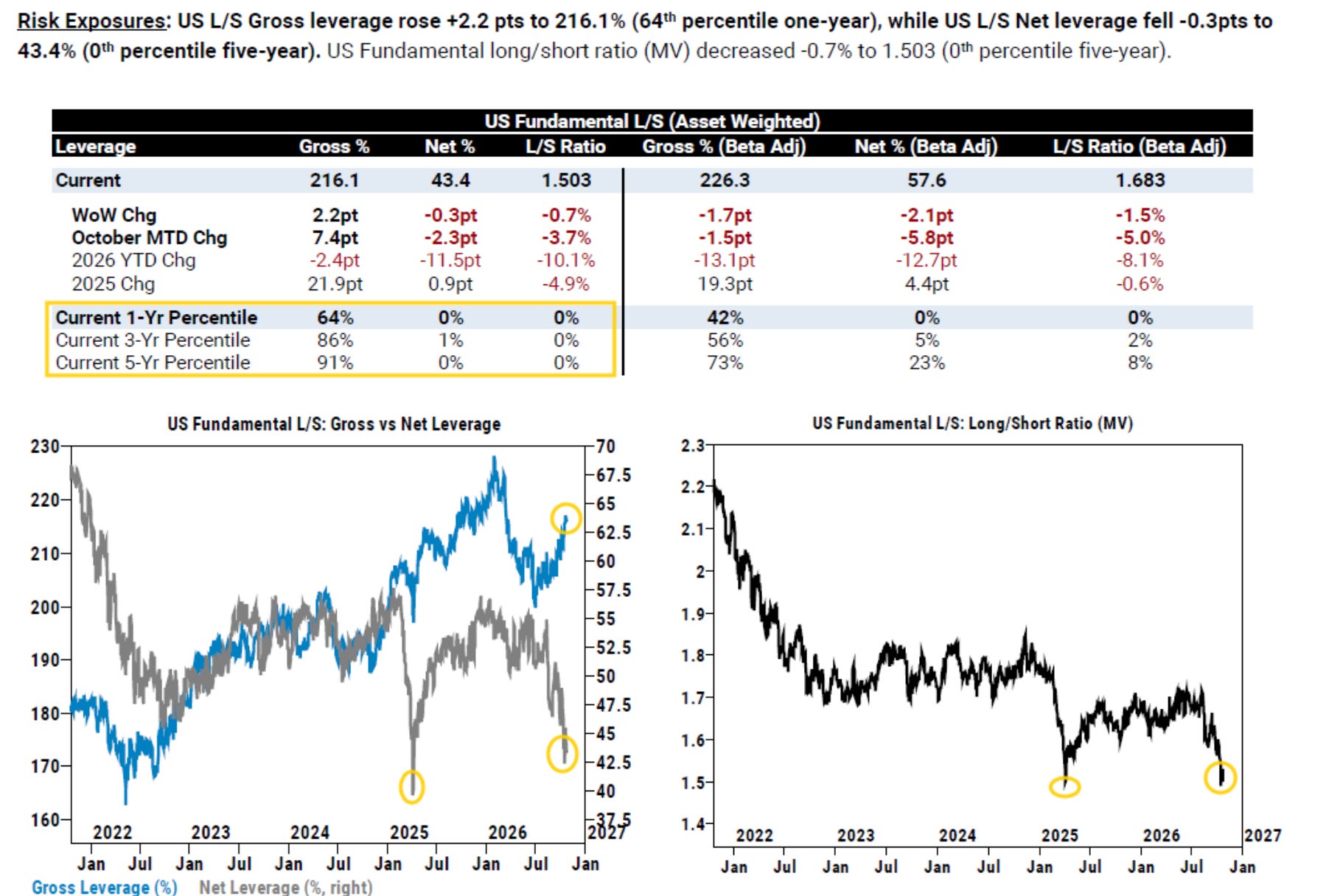
De-grossing has largely come at the expense of Nets, not Gross. According to GS, Global fundamental long/short net leverage is near a 3-year low (4th percentile). Gross still sits at 90%+ percentile
Some charts from GS via neilsethinew on X:
AI semis continue to get sold as investors grapple with the fallout of slowing ARR lab revenue and increasing financing risks (more on that later). Plenty of stocks/sub sectors now below the Leopold Low:
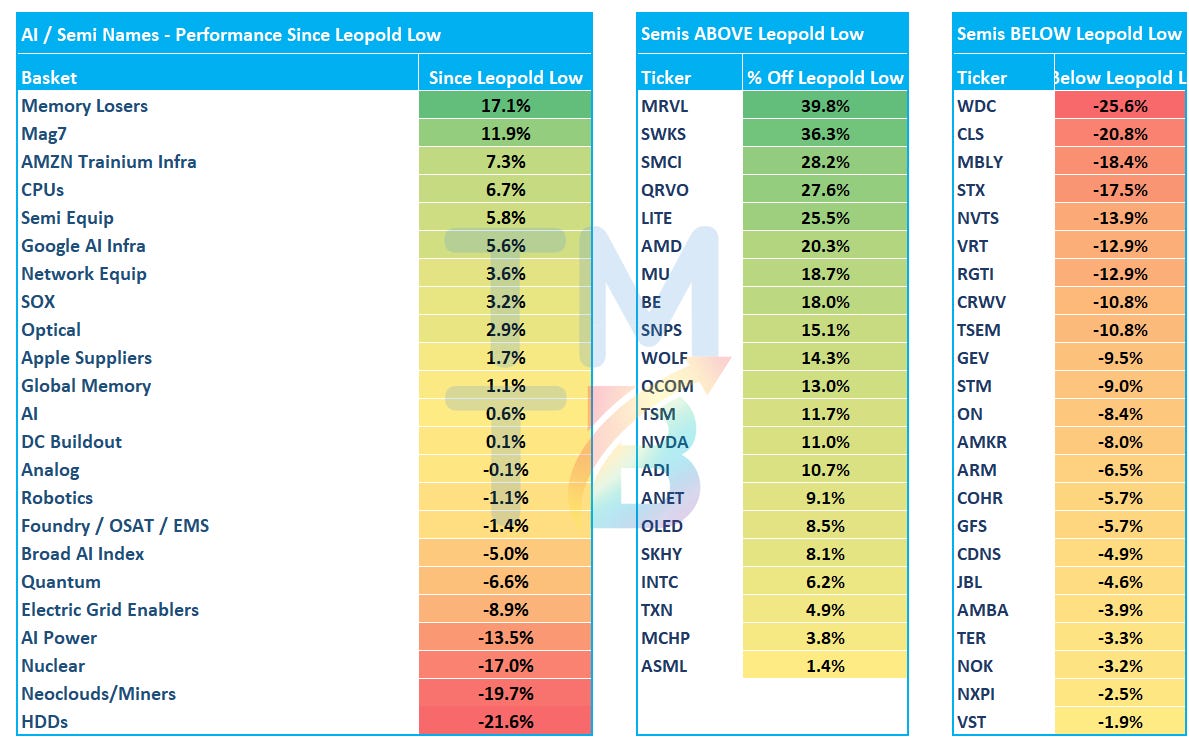
Price action isn’t great either: WDC down 3% on beat and raise despite the stock down 20% in a straight line since the beginning of Oct; SMCI has given back most of its positive pre-announcement pop; and semi caps took a beat on LRCX weaker guide.
LRCX now has roundtripped the whole move since the early April AI semis ramp began:
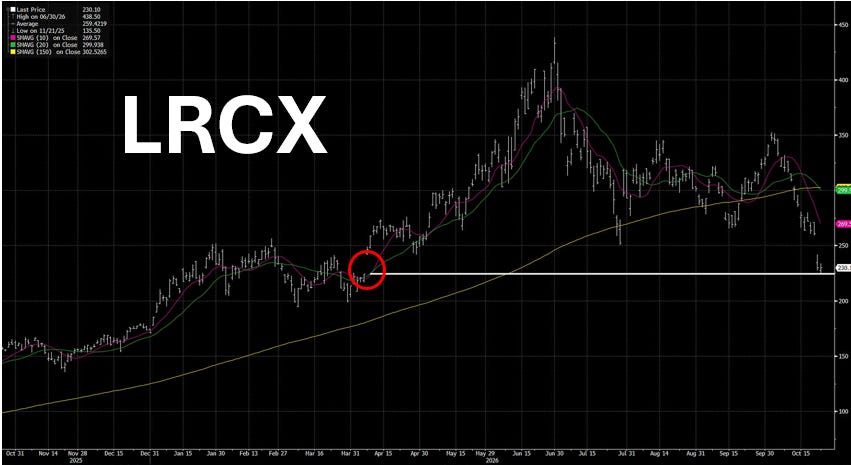
Pretty shocking chart. Not a bad r/r spot there to try long, but want to see that gap held if not going lower. Good tea leaf to watch for broader space.
Semis stuck in no man’s land approaching the 200d:
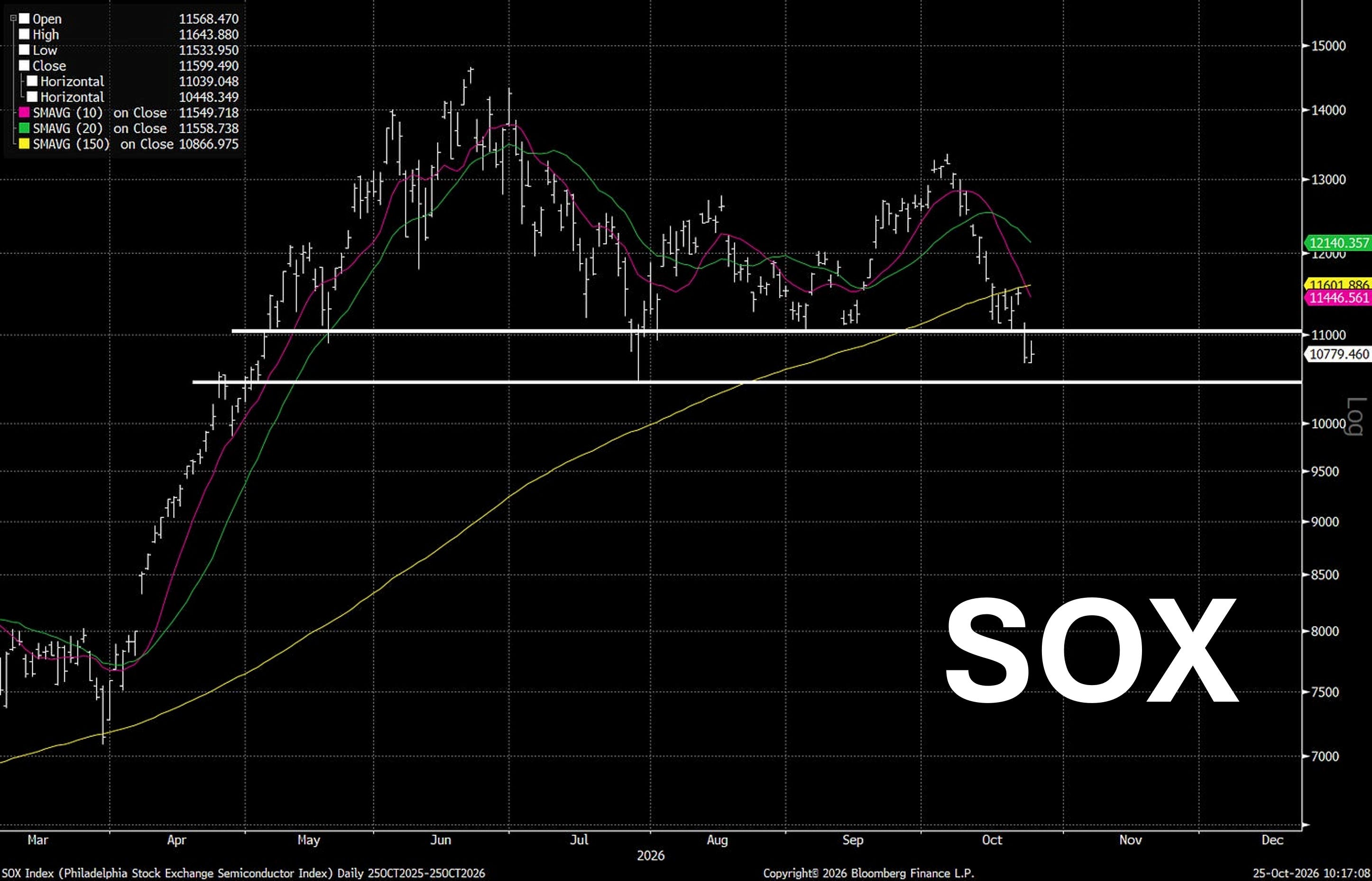
No other way to describe the vibes in semi land as something other than “sad” right now.
Meanwhile, in software land, things are feeling a lot better. Equal weighted SW is breaking out:
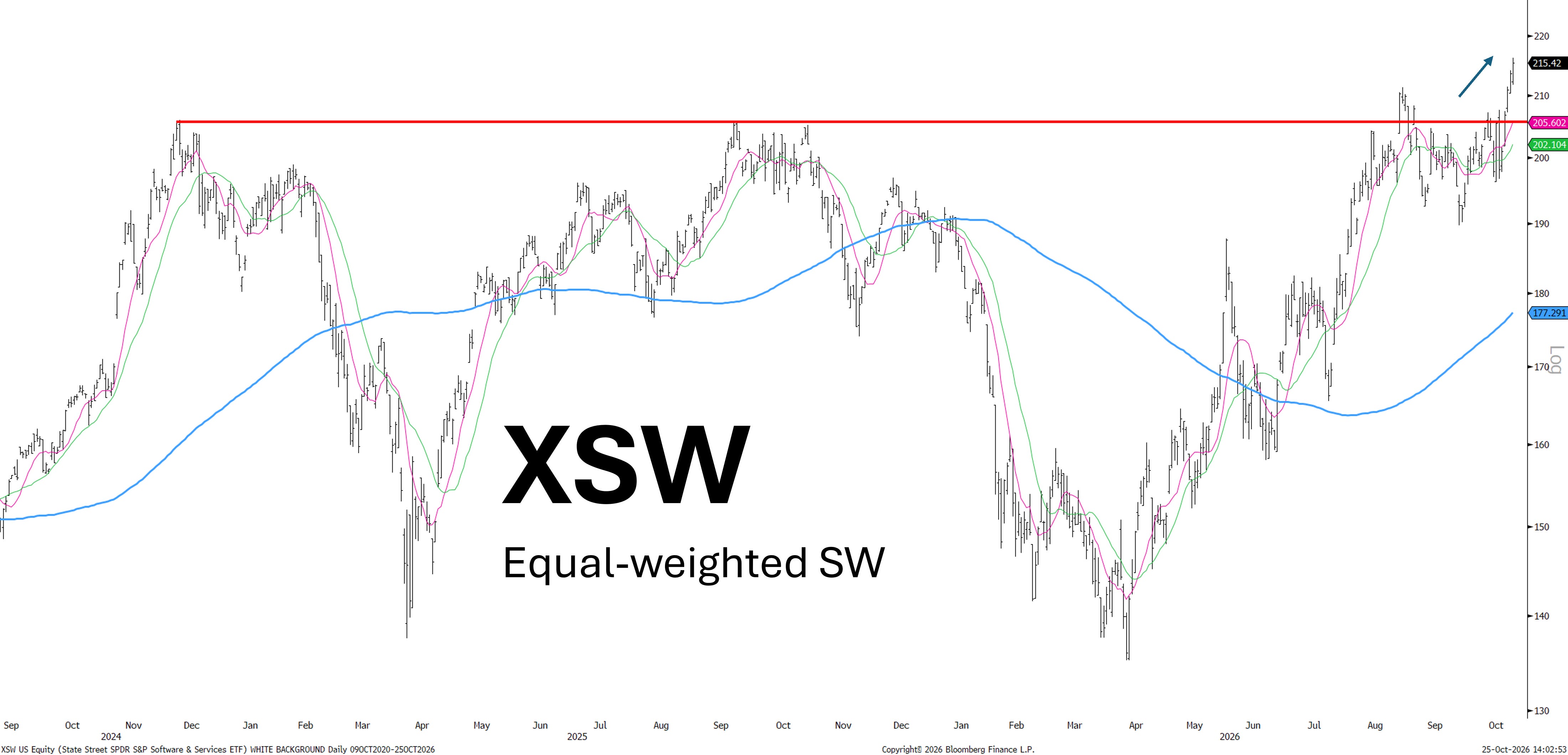
That looks like a chart that wants much higher. Cloud consumption, Cyber, and buckets of the higher quality app sw names (NOW, TEAM) leading the way higher here.
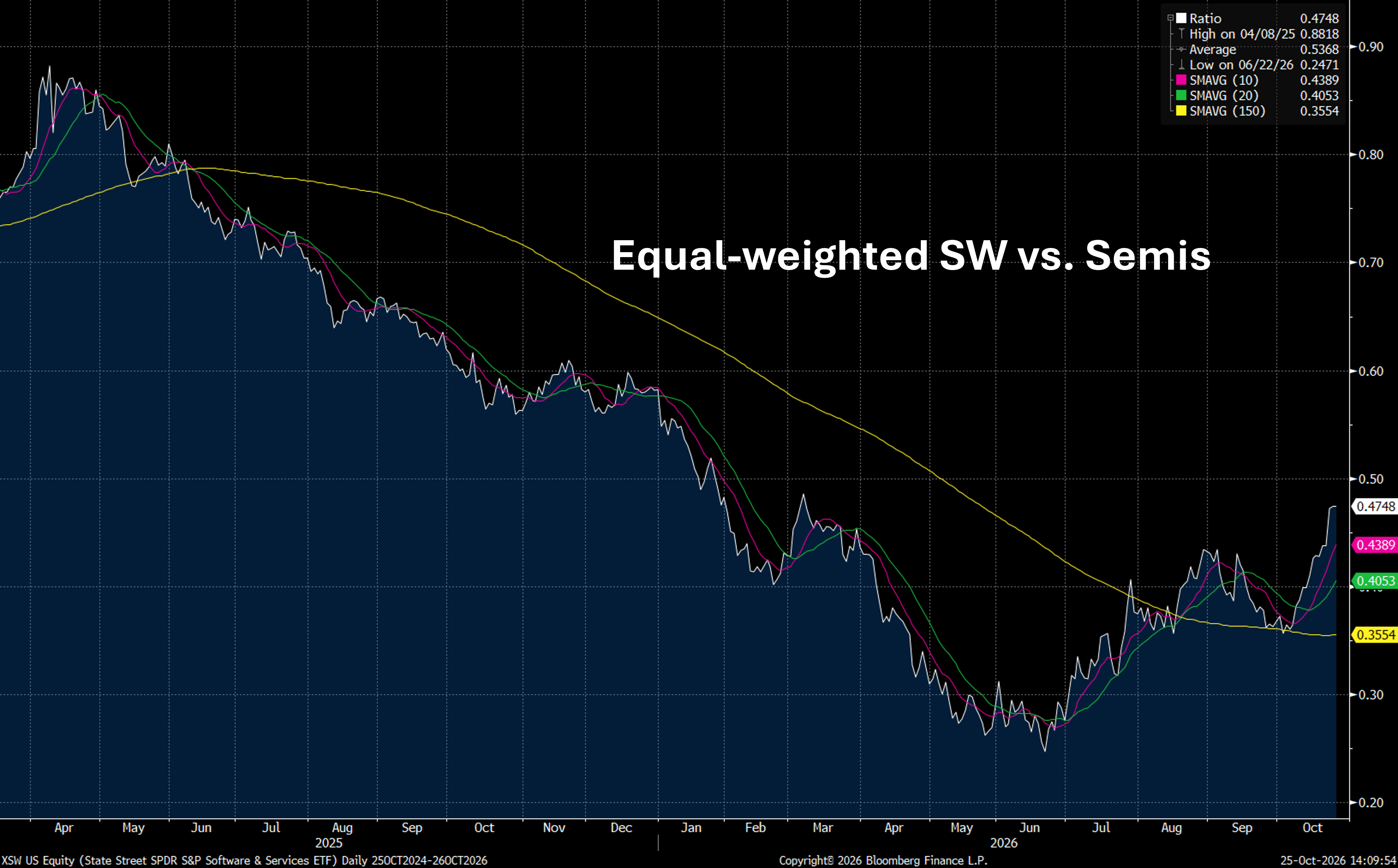
Price action here has been the opposite of semis. Just check out a name like TTAN which is up 60% in a straight line after being down 30% post-print in early Sept. Our sense in conversations is that tech investors are generally still underweight sw and companies have a relatively low bar heading into earnings. Outside of the names in the AI loser basket (HUBS, MNDY, INTU, etc.), we are interested in hunting names and moving quick on sw prints that show accelerating top line with potential narrative inflections - happy to buy up early on those in sw this earnings season.
The end of the Honeymoon period - what comes next for the AI trade?
The past few weeks have been painful for AI semi investors. One of our mistakes early in the month was not realizing how much of an impact Anthropic’s ARR print would have on the AI trade, and not “sussing” out the set up heading in: lower distillation revs, OpenAI taking share in September, & META/MSFT off-ramps. These were all things that were reported on; if this was an earnings print, we wouldn’t have wanted to be long in the weeks heading into it. In hindsight — knowing what we know now, it was a perfect set up to reduce exposure into it.
The upside of whiffing on that trade and the market’s renewed focus on Lab ARRs and financing? It has forced me (and other investors) to sharpen our pencils and better understand the different moving pieces of the trade, and how they play off each other.
Let’s rewind a bit before diving into where we are now:
For the first three years of the AI semi trade, and especially during the May/June go-go days, investors were in the throes of the honeymoon phase: maximum arousal, minimum scrutiny. Every piece of news was looked at with rose-colored-glasses. It’s just like the beginning of a new relationship when the infatuation is so strong that your partner can do no wrong. Even when she tells you she believes in an "open-source relationship," you somehow hand-wave it away and convince yourself it’s just going to soak up more of the frontier labs' excess demand. When your level-headed friends pull you aside to point out glaring red flags, like the fact that she’s running a shadowy circular-financing scheme with her roommates, you don’t listen; you just stop inviting them to parties. Before you know it, you’ve turned on Gavin Baker’s X notifications and forward SemiAnalysis to anyone who thinks you’re moving too fast, the ultimate wingmen who never stop hyping her up and telling you what you want to hear. “It’s way bigger than just coding, bro. She’s going to replace the entire global labor force.”
Before long, the endorphins and dopamine completely take the wheel. Even if you carry the scars from past relationships — whether the early 2000s, GFC, 2019 SaaS, or the 2020–2022 Covid binge — the blinders go right back on. Those exes weren’t real supercycles and everyone knows there’s no dark fiber in GPUs, you tell yourself as you start at GPU rental prices. You’ve even picked out baby names: Bel if it’s a girl; Claude if it’s a boy.
But eventually the dopamine wears off, and you have to get to know the person you’ve been telling everyone is perfect. You begin to see the flaws and start asking practical questions about spending habits, expectations, whose money is actually paying the bills. Can we afford this lifestyle on those lab ARRs, or are we just annualizing the honeymoon and assuming the capital stays cheap forever? And is there enough power in ’28 to keep the spark alive?
Things suddenly feel a lot more complicated, and we feel some investors longing for the simpler, more intoxicating days of May and June. But we see the end of the honeymoon as a chance for the relationship to mature. That means accepting where we are, adjusting expectations, and focusing our attention on where the strengths are rather than the flaws.
You are reading TMTB Pro. For more info or a trial, e-mail sales@tmtbreakout.com