


Happy Sunday. Ok let’s start with the obvious news this weekend. Many — including myself — were looking forward to the weekend to take out Fable for a test coding run, but that didn’t come to fruition as USG issued an export-control directive barring foreign nationals from accessing Fable/Mythos, which forced Anthropic to pull both offline just three days after launch (I already miss it).
From what we know, it seems like AMZN brought a jailbreak to the attention of the USG and Anthropic said the jailbreak used to justify the order was narrow, surfaced only known and relatively minor vulnerabilities, and offered nothing unavailable through other public models. Many unknowns as we sit here Sunday (including how long the export directive lasts). We’ll get more reporting over the next few days. We don’t know all the facts yet and there are plenty of takes on X exploring all sorts of different angles if you want to go down that rabbit hole, but that’s not what we want to spend time on today.
What we can be sure of is that it continues to bring the sovereign issue to light even more. It’s not a coincidence this directive comes on the back of increased National Security focus on frontier models. We had rumors of USG taking a stake in the frontier labs last week. We had a month of US agencies tightening up cyber security risks with Mythos. On June 2, Trump signed an executive order on AI and cybersecurity that, among other things, invites frontier developers to give the government up to 30 days of early access to new models before release. Days later, on June 9, reporting surfaced that China is preparing to spend roughly $295 billion over five years on a state-directed buildout of domestic AI data centers. While no one knows how this continues to evolve, I think the news this weekend is just part of an ongoing pattern of the U.S. government increasingly looking at frontier AI from a strategic asset perspective vs. a purely commercial one.
This likely accelerates the already ongoing trend of enterprises not having single-model dependency. Now it increasingly becomes table stakes. This also vindicates Europe’s sovereign-compute push (Chips Act 2.0, CADA, etc) and potentially pushes more sovereign countries to do the same. More questions to think about: does it also further increase the push for domestic chip production (INTC the obvious main beneficiary here)? Does this further slow the pre-release gating the Trump exec order defined or does the cadence stay the same but just get adjusted forward?
In our minds, it’s very hard to imagine the government actually wanting to slow frontier model progress given it’s becoming an increasing national security issue, but how model releases look and how they get accessed will be different in the future. For the hyperscalers, though, the open question is whether a government gate actually disrupts the stack at all, or simply thickens the compliance layer already wrapped around it.
These issues and questions aren’t going away. But assuming this particular directive gets resolved fairly quickly (and we are assuming it does according to initial reporting) —
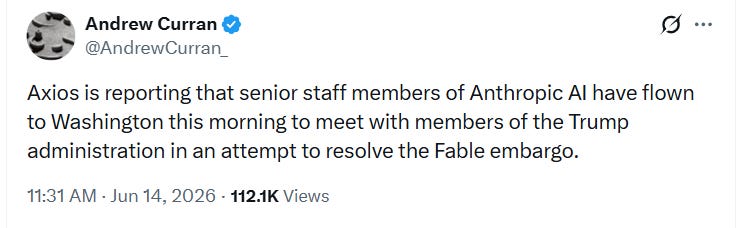
— and doesn’t snowball into something unexpected (still possible), we don’t think this affects the AI semi trade in any significant way. It’s possible there might be a very small air pocket of token demand if this lasts more than just a few days however as I’ve heard several people ask: “why spend time coding with Opus 4.8/GPT 5.5, when I can just hold off and finish something better in a lot less time once Fable comes back online.”
Ok now onto the good stuff. Which stocks come out of this looking more attractive?
You are reading a TMTB Weekly, part of TMTB Pro. For more info or a trial to TMTB Pro, please contact sales@tmtbreakout.com