


TMTB Weeklys are part of TMTB Pro. Please e-mail sales@tmtbreakout.com for more information or a trial. Discounted retail pricing available.
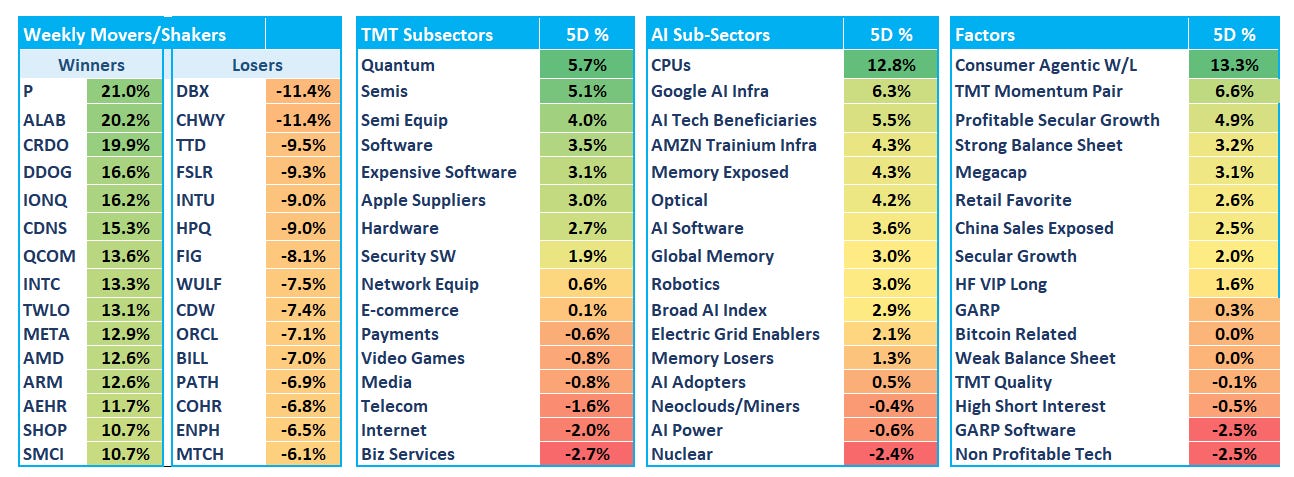
Happy Sunday. Another fun week in Tech land as QQQs finished +3%, with semis +5%, META +13%, and CPUs +13% leading the way higher.
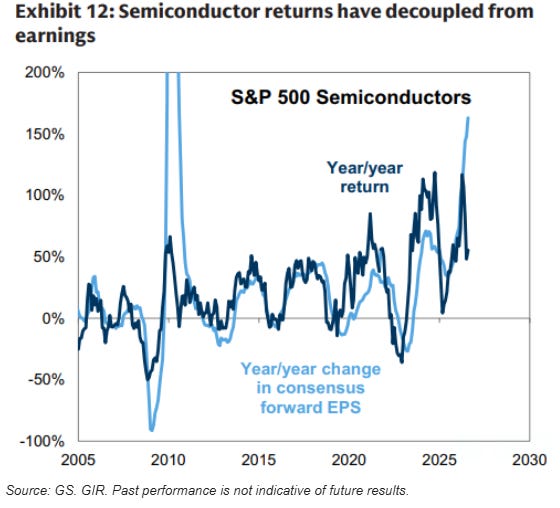
We’ll skip the macro this week (yields at new highs, an October Fed hike, TACO hopes for the week, yadda yadda), other than to say we’re sticking with the choppy but upward-trending call we’ve had since the “Leopold Lows.” For semis, the big debates remain: the trajectory of frontier ARR, how quickly open source is catching up to frontier models across workloads, and the power supply gap in ’27/’28. Semi investors continue to be skeptical on the answers to all these questions, which has caused returns to decouple from earnings. Good chart from GS:
Is consumer agentic AI the next great driver of compute demand after coding? The jury’s still out, as we discuss below. Let’s get to it…
Investor conversations and news flow have centered on META’s Muse and consumer agentic AI over the last couple of weeks. Heading into last week, the hype cycle was in full force, and it didn’t take a ton of deep fundamental work to figure out the trade: perceived consumer agentic winners would keep outperforming the losers. That initial wave of enthusiasm seemed to peak on Wednesday heading into Thursday:

The trade reversed a bit on Thursday and Friday: FSLY gave back all of Wednesday’s ~14% pop and then some, TWLO fell 8% on Friday, ARM is dn 7% from its peak and losers like BKNG/ABNB (+4%) and DASH (+3%) caught a bid. Trading Tech is fun. An entire investment cycle now fits between two weekly wraps. Some weeks it feels like the hype cycle has compressed from what used to be months and years into weeks and days. The first couple of weeks after Muse’s 9/8 launch were shoot-first, ask-questions-later price action, and we saw the type of workflow we witnessed from PMs (and retail investors) at the beginning of ’26 during the SaaSpocalypse: ingest theme → Claude → trade.
Near the end of the week, conversations we were having began to shift to a more realistic look at numbers, issues and impact. Fewer 🚀 emojis, more digging into what this could actually mean.
It’s no coincidence to us that META stalled ~13% shy of $900 (investors generally settling in at 25x CY27’s $36). We don’t think the recent move is unjustified: we just had a massive 180 in the narrative (sentiment was hovering near lows on both the stock and the multiple), and Zuck has landed every product launch over the last couple of weeks (so far). The re-rating and sentiment reset higher feel fair and justified. Yet there are still unanswered questions around agentic consumer AI.
The bulls will say everyone with a smartphone will have at least one Muse-like personal agent (with its own hardware, living in a virtual machine) and at least one professional one. The case for a personal agent: everyone has kids’ school schedules, bills to pay, groceries to get delivered, meal prep to do, calendars to manage, etc. Muse today is reasonably good at this stuff and will only get better.
Yes, Muse downloads are off to a good start (#1 on the US App Store since 9/18, ~3.4M downloads through Thursday) and META seems supply constrained on compute, but my own personal experience dovetails with the CNBC poll cited below, re-iterated by OpenClaw’s founder Peter Steinberger:
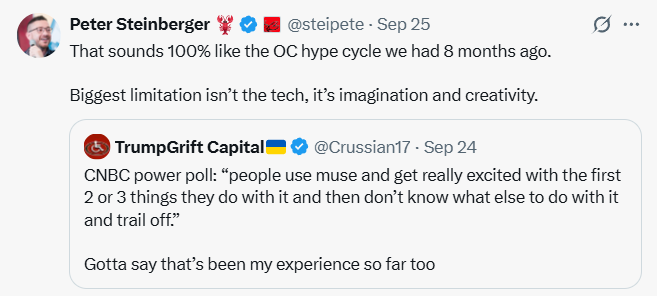
Now, I generally work on my desktop, so anything I can have Muse do, I generally do with Codex or CC anyway. For normal use, though, Muse does feel smooth and fast, with little hurdle in picking things up vs. Codex. Point still remains: it’s an open question how big and how quick consumer agentic AI takes off. FUNDA had a good report showing the top use cases among those who have tried it and use skews toward one-off items (negotiating bills, recovering unclaimed funds, rebuilding a website) rather than daily habits:

It’s also unclear how much consumer shopping habits will actually change. Yes, Muse looks like the best consumer agentic product out there, and AMZN’s Alexa for Shopping is gaining traction. But Alexa is integrated into AMZN’s existing shopping experience, which is different from convincing consumers to make a standalone agent their first stop. Nearly four years into the chatbot wave, it’s worth asking why we still hear much more about AI helping people research purchases than becoming their default way to shop. Here’s APP’s CEO musing on that:
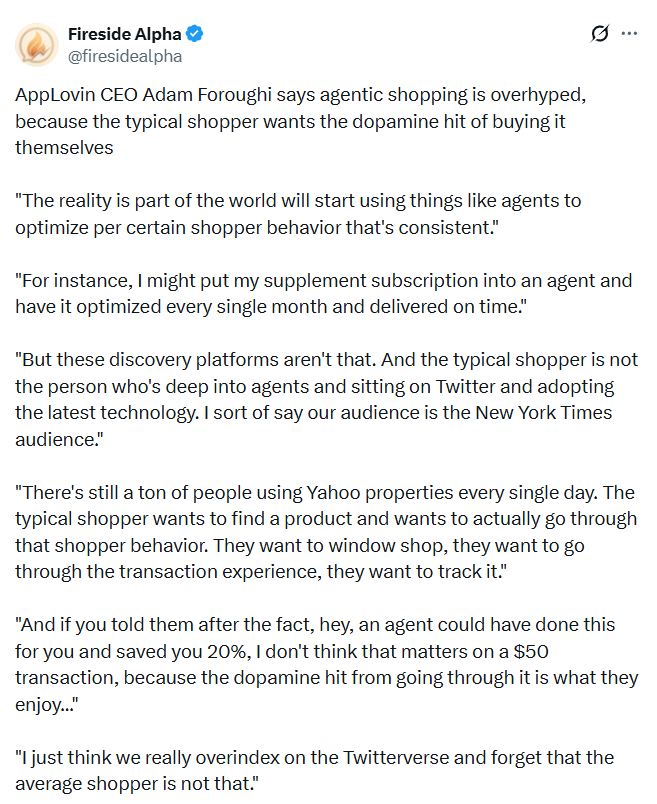
Other issues: trust, patterned behavior, habits (people wanting to look up results themselves), etc. It was only last month that Sam Altman said he surprises himself with how much he still manually clicks around, copies things between apps, goes through his own inbox and keeps a to-do list when Codex can do all of it. Basically admitting he knows there’s a much better AI-native way to work, yet still works the old way out of habit.
Is Muse the iPhone moment in product design that actually gets people to abandon their old workflows? Possible, but that’s still an open question, and we don’t think we can answer it in Muse’s first month.
For the first few weeks Muse was the shiny new toy in town and we know how much Tech investors love a shiny new toy, but easy money in the trade has been done, which means META likely chops around more than breaks out to new highs in the near term. While Zuck has laid out promising ideas on how to monetize this (free for most of what people need, paid tiers for power users, and over time “a small fee from transactions”), reality is this is unlikely to hit the top line in any meaningful way until ’28, either on a subscription or commission-cut basis. Getting to 15% away from 25x ‘27 numbers seems like a logical spot for it to take a rest. For the perceived losers like DASH and the OTAs, we think UBER’s experience with AVs is a useful template: a stock can spend a long time ping-ponging around disruption headlines even while the underlying business keeps growing and bulls keep pointing to cheap FCF multiples while the underlying bigger picture narrative & thematic debates remain unsettled. It seems like UBER has remained in $70-$80 purgatory for as long as I can remember.
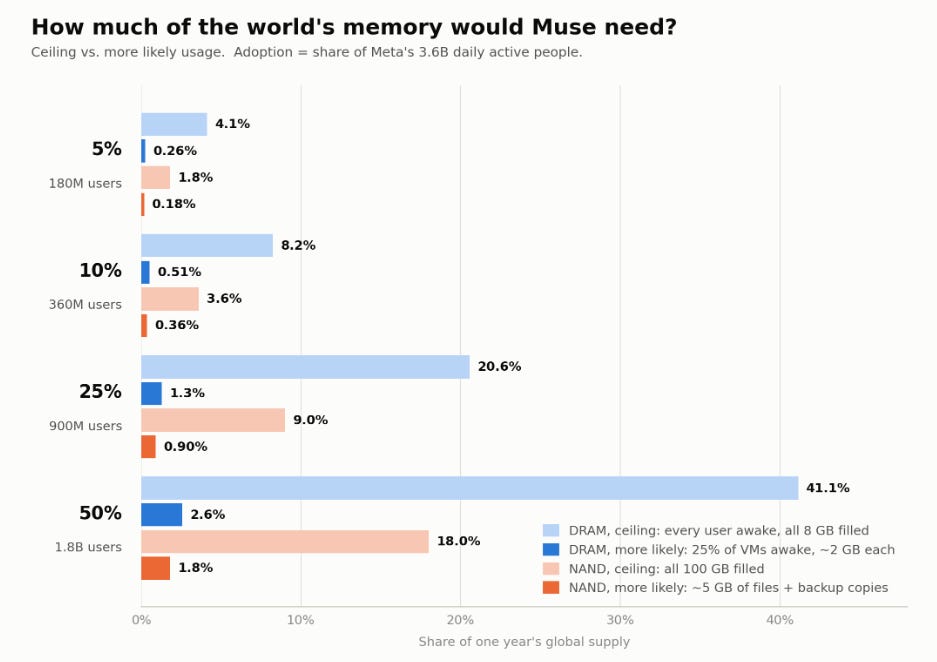
Moving past internet, there’s the question of how much of an impact this even is to memory and CPU, even assuming consumer agentic takes off. Last week we showed the chart below on memory showing it likely wasn’t going to be a huge impact if you assume 25% of users are awake at any given time and only a portion of DRAM/NAND is used by each user. Even at 25% adoption (900M users), that’s ~1.3% of a year’s global DRAM supply and ~0.9% of NAND:
Late in the week there was a good amount of discussion in TMTB Slack about what this actually means for CPU demand. Friend of TMTB Freda Duan took a stab at the infra math over the weekend and concluded the sandbox layer is much smaller than many expected: serving 100M Muse DAU takes ~1 GW in her base case, but only ~0.1 GW of that is the CPU/VM layer (sub-$1B of CPU content, or ~65K 192-core CPUs, plus ~$2B of DRAM). The 2 vCPUs per user are a ceiling, not consumption and idle VMs get snapshotted and paused and CPUs get pooled across users (memory is what can’t be shared), so what matters is concurrent active agent-hours, and on that math even 100M DAU is under 1% of a year’s CPU supply:


Back in Slack, members struggled to get the math to explain the price action:
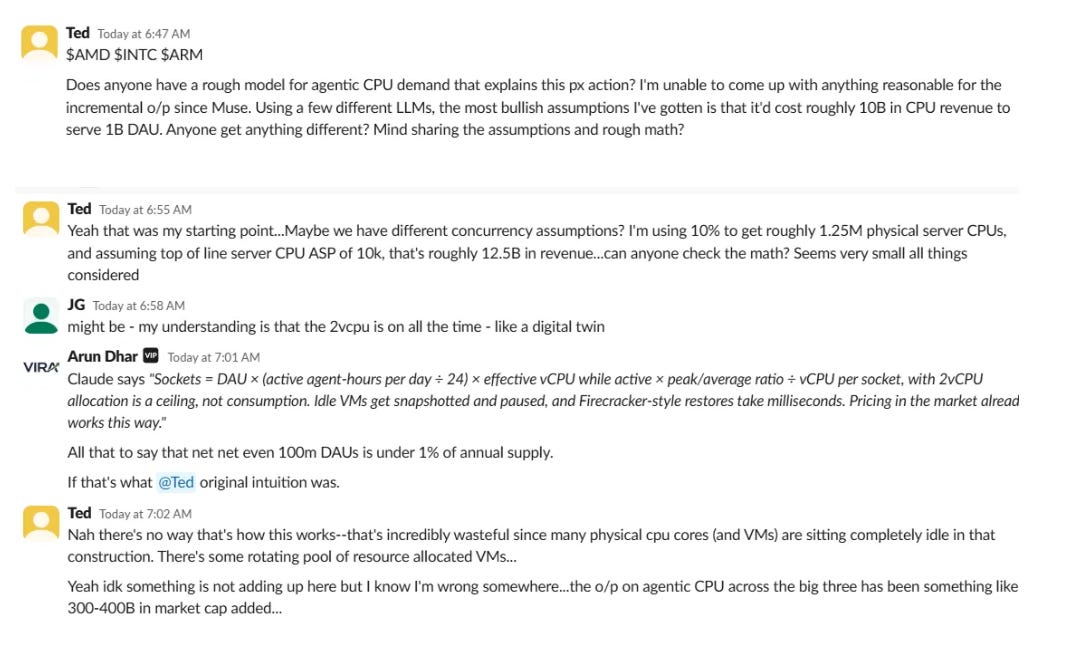
Net net, it’s hard to get the Muse math anywhere near the CPU move. Scale either the most bullish member math (10% concurrency → ~1.25M server CPUs at ~$10K each) or Freda’s to 1B DAU and you get roughly $8–12.5B of CPU spend, vs. the $220B server CPU TAM on agentic AMD has thrown out. As Arun also pointed out: most of those tokens would have come from ChatGPT/Gemini/Claude anyway, so stacking Muse on top is double counting.
Listen, I love the CPU theme but the last two weeks it was buy anything tangentially related to Muse. We’re still seeing some of that as DDOG’s move Friday shows after Wolfe called it out as a potential Muse beneficiary. We’re not begrudging that: it was a good two weeks for us and many others. But we’ve moved past that point in the hype cycle: it’s clear it’s been more of sentiment catalyst than an estimates one for CPUs. We’re not bearish CPUs or META, but likely think both need to digest/consolidate the recent move a bit.
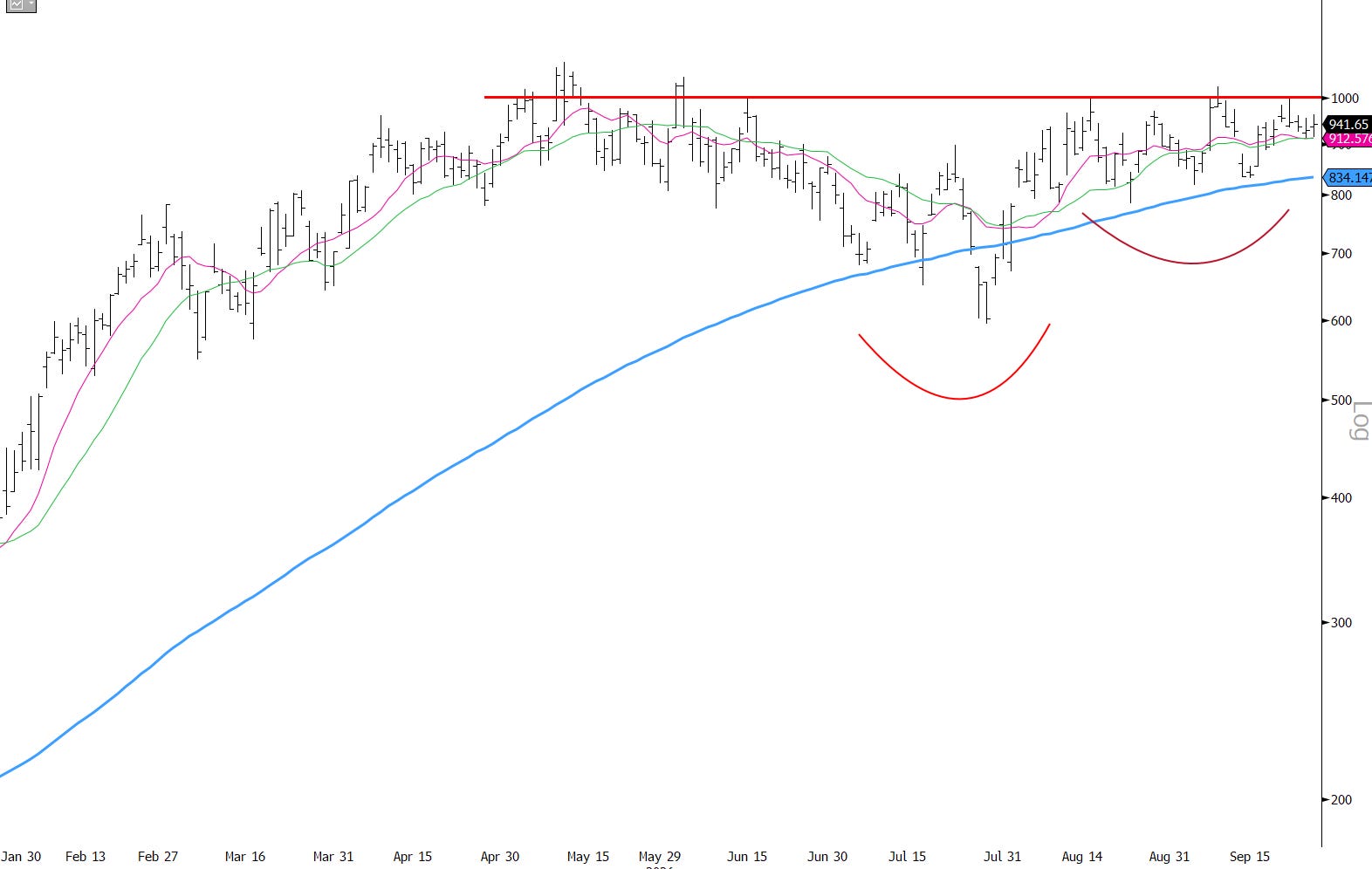
It’s unclear to us — and other semi investors in our conversations — what is next line to take the baton in AI semi land outperformance after CPUs as we head into MU earnings this week. Our favorite charts in the group are probably BE & LITE. BE benefitting from scarcity value of one of the few BTM plays. LITE: we like the narrative & checks and mgmt continues sound incrementally better:
Where do the flows from META go?…
MSFT: Was Friday’s announcement MSFT’s Muse moment?
MSFT rallied 3.5% Friday after announcing a more unified Copilot built around agents that do work rather than just answer questions. Think “manage these invoices and follow up with people,” rather than just “summarize this email.” Everyday Copilot use remains subscription-based, while heavier work through Cowork, Code and Autopilot is billed based on usage.
We were encouraged by the announcement, but don’t think it kicks off a Muse-like hype cycle in the near term. Muse took off as a consumer product with fun, instantly relatable use cases like saving $500 on a VZ bill people could post on X. MSFT’s pitch is a lot more boring, though potentially no less valuable, but getting companies to trust agents with real workflows takes time and organizational buy-in, not just downloading an app on your iPhone.
Instead, we think the move on Friday goes back to what we have been writing about this week: scarcity value of good clean ideas in this Tech tape

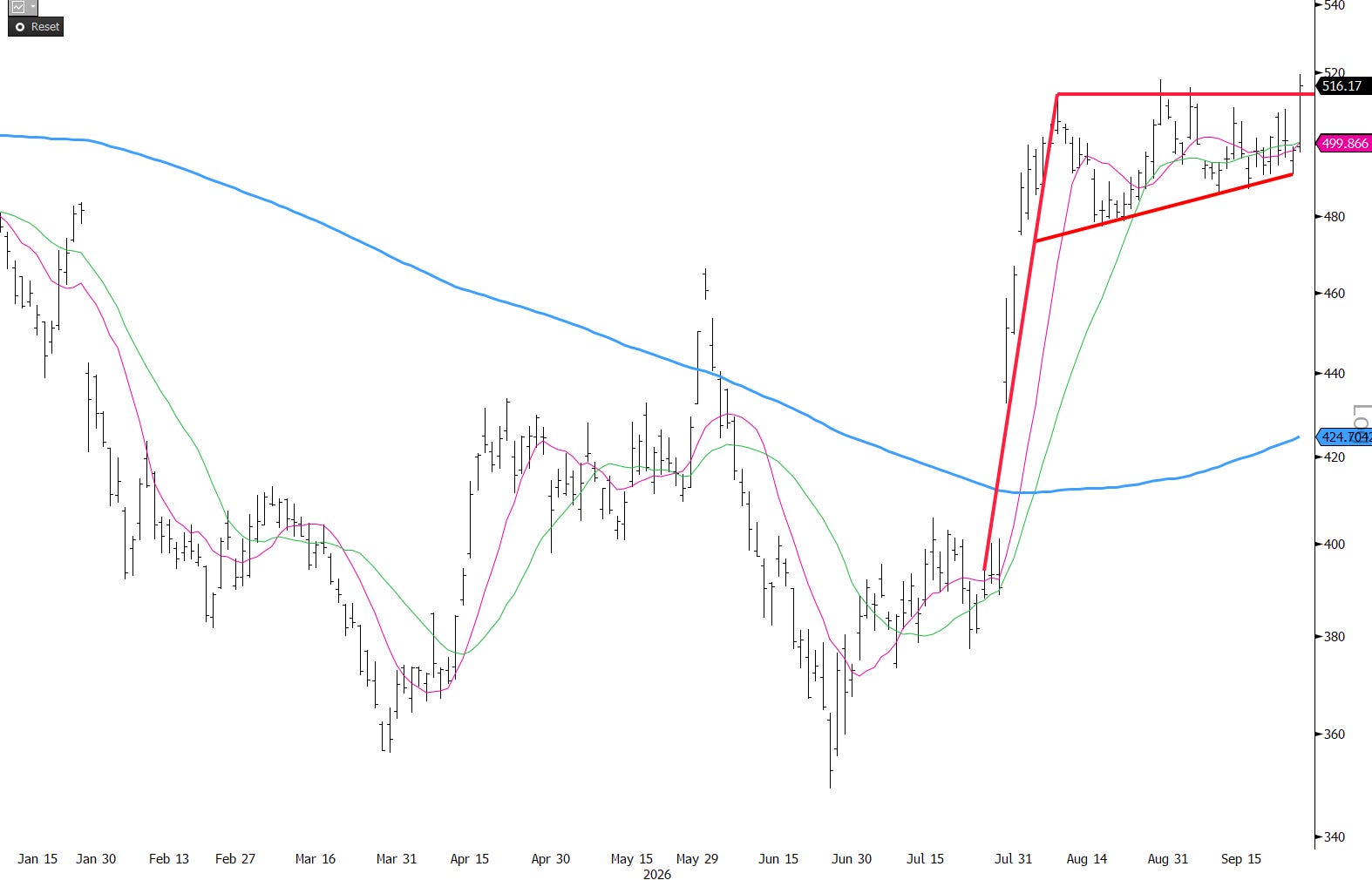
With META set up for some digestion after it’s big move, and AMZN/GOOGL’s narrative more muddied following the Muse release, MSFT seemed like the nice logical target for flows late in the week. The chart was already looking primed for a breakout after its nice tight consolidation following their numbers & narrative EPS inflection:
We think MSFT is likely set up for some near-term outperformance into earnings in late October where we think Azure prints in the high 40s.
Buyside in the low 20s in FY27 and mid 20s in FY28 for EPS. At a conservative 25x multiple of FY28 $25, that’s $625+. The measured chart target out of this bullish flag is pointing to something similar. We continue to like it here.