


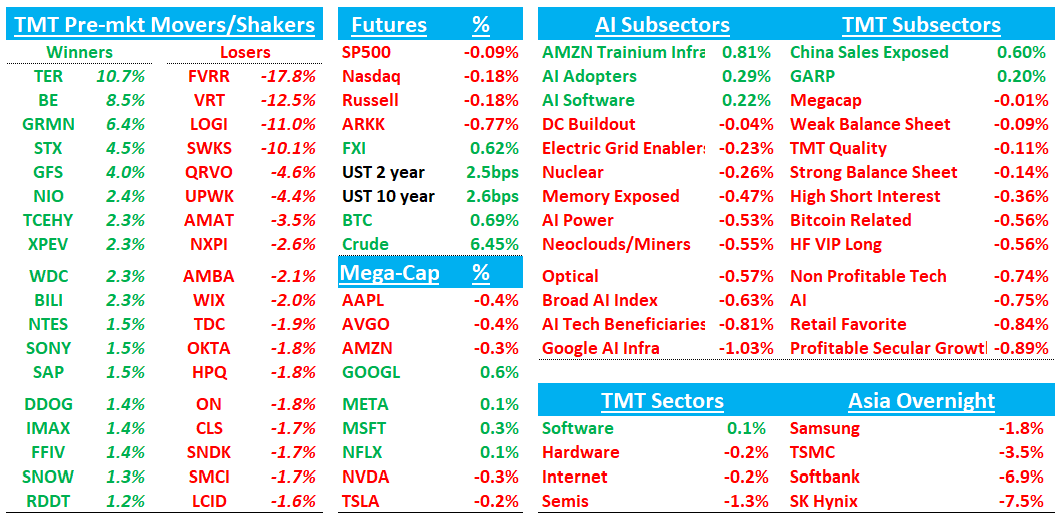
Good morning. Futures slightly red, rates slightly up and Crude +6.5% ahead of the Fed later this afternoon as some Iran launched missiles at a base in Jordan, the first such attack since Trump suspended strikes on Iran on Friday. Semis -1% weaker early while software/internet are flat. Overnight, KOSPI down another 6% and now down 45% since peak and hitting 200d. What a ride. Hynix finished down 5% after missing OPs estimates. What a ride.
Lots of earnings to go through. We’ll cover STX, Hynix, KLAC, NXPI, VRT, and CTSH then the usual below that. We’ll put our recap of BE in the slack since we’re running out of time here…
META and MSFT tonight among others. We’ll have some bogeys out shortly.
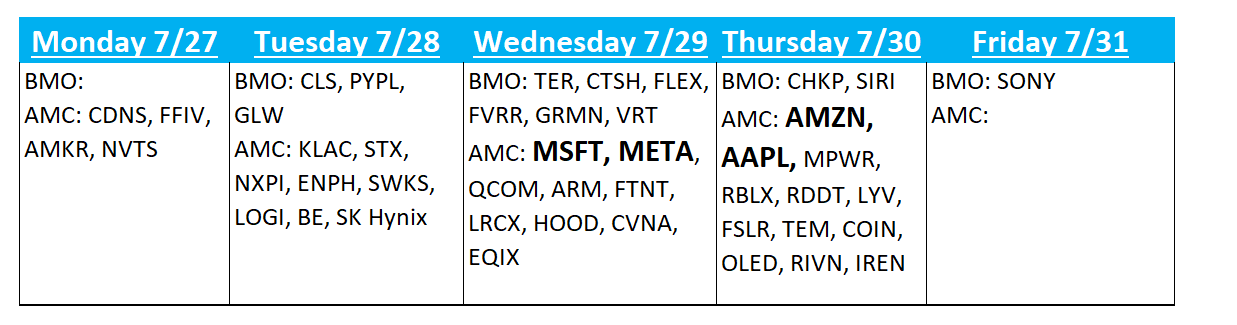
Let’s get straight to it…
EARNINGS
STX +4%: Big beat-and-raise, with pricing, mix and HAMR cost-downs driving a much larger-than-expected margin step-up, while demand visibility extended into CY28 and customer planning moved into CY29+
Overall very solid print with the highlight the implied mid 57s September GM guide. We know what kind of tape we’re in but numbers objectively good and mgmt did good job talking up visibility/pricing/incremental margins. Will be interesting to see how it goes today.
The #s:
FQ4’26 revenue was $3.629B, +48.5% y/y (last q +44.1% y/y) vs Street $3.49B, +~42.8%; non-GAAP EPS was $5.71 vs Street $5.08-$5.10; GM was 52.7% vs ~50.3%; and OM was 44.6% vs ~42.0%.
FQ1’27 guidance was $4.10B revenue, +56.0% y/y vs Street $3.78-$3.79B, and EPS of $7.30 vs Street $5.80-$5.85 and a roughly $7.00 buyside bogey. Implied September GM of ~57.3%-57.5%…The magnitude of the EPS upside came from the combination of another pricing increase, a higher-capacity product mix, HAMR cost-downs and opex remaining near $300M despite 13% sequential revenue growth
Key Takeaways:
Pricing: Nearline pricing increased roughly 10% y/y, accelerating from approximately 6% last quarter, while Edge pricing increased roughly 35% y/y. Mgmt said the supply-demand gap has widened, and any incremental exabytes produced above contracted volumes are being sold at prices above the original contract price. The favorable pricing expiration for one early HAMR customer was only a small contributor to the September improvement, with broader demand and customers chasing incremental volume the more important drivers.
GMs: GM reached 52.7%, +570bps q/q and nearly 15 points y/y, while the September guide implies ~57.3%-57.5%. Estimated incremental GM was roughly 87% in June and 93% in September, far above the 50% framework previously discussed. Pricing, cost per TB declining by roughly 16% y/y, higher-capacity drives and limited opex growth are translating revenue upside almost directly into earnings. Mgmt said GM should improve sequentially through FY27 and that incremental GM is already well above 60%, but explicitly declined to identify a ceiling.
Visibility: Approximately 90% of exabytes now ship into data centers, the vast majority of nearline supply is allocated into CY28, and customers are discussing CY29 and beyond. Product configurations and pricing are already contracted through the entirety of CY27. Mgmt said cloud exabyte demand has increased sequentially for three years with “no evidence of a slowdown,” while enterprise nearline revenue increased for a fifth consecutive quarter.
Demand: Mgmt argued that inference and agentic workloads create and retain more context, with tiered KV-cache architectures allowing HDDs to hold persistent data and reduce repeated GPU computation. Neoclouds, leading model developers and enterprises are also starting to adopt hyperscaler-style tiered architectures. However, mgmt repeatedly characterized agentic KV-cache and physical-AI demand as “very early days,” and said the ultimate HDD attach rate will vary significantly by application.
HAMR: HAMR represented approximately 40% of nearline exabytes exiting FY26. Mozaic 3 is qualified across all major cloud customers, Mozaic 4 is ramping at the two largest global CSPs and should represent 50% of HAMR exabytes exiting CY26, while Mozaic 5 qualification shipments remain targeted for late CY27. Mozaic 4 was already a meaningful contributor in June and is expected to contribute more in September.
Capital Return: FCF was $1.118B, a 31% margin and the best quarterly result in more than a decade. Gross debt declined to $3.6B, STX plans to retire another $1.2B during the September quarter, and buybacks are already running above the June-quarter level. Once the remaining targeted debt is addressed, mgmt expects most excess FCF to be returned through repurchases and dividends.
Bull vs. Bear Debate
The structural bull case is that STX is no longer simply a cyclical PC-HDD vendor. The business is becoming a concentrated provider of mass-capacity storage into a rational cloud-HDD market, where HDD remains dramatically less expensive than NAND for bulk storage. Approximately 90% of exabytes already ship into data centers, HDD represents a relatively small portion of total hyperscaler capex, and AI is increasing the amount of data that is created, retained, duplicated and reused. Bulls argue that this makes storage demand more durable than compute capex alone, particularly as inference, agentic AI, video and physical AI increase persistent context and unstructured-data requirements. Bulls like bisibility and supply discipline: the vast majority of nearline exabytes are allocated into CY28, pricing and product configurations are contracted through CY27, and customers are already discussing CY29+ with most checks showing $25-$30/TB already in CY27 which implies $70+ in EPS power. STX is keeping drive-unit output broadly stable and using areal-density gains to increase exabytes, which limits industry oversupply while allowing incremental production to be sold above contracted prices. Bulls therefore believe that the traditional HDD cycle has structurally changed: rather than price per TB falling every year, the industry can capture part of the value created by higher-capacity products while HAMR lowers cost per TB.
This quarter the September guide cleared the buyside bogey, Edge pricing showed the same positive inflection as nearline, incremental GM approached 90%, and Mozaic 4 is now contributing meaningfully. Opex remains near $300M even as revenue approaches $4.1B, creating unusually high earnings leverage. With debt rapidly declining, the next leg of FCF can increasingly fund buybacks, allowing EPS to grow faster than operating profit. Bulls will say this should trade at least mid teens multiple and with pricing reaching $30/TB by 2028, you can get $100+ in EPS power = a $1,500 stock.
The bear case is that the market may be capitalizing peak pricing and peak incremental margins as though they are permanent. Customer commitments reduce near-term miss risk, but they do not eliminate a CY28 or CY29 cloud-capex slowdown. If hyperscaler infrastructure spending moderates, open-source models reduce the capital intensity of AI, DC construction encounters power or financing constraints, or customers eventually discover they have accumulated too much storage capacity, pricing can flatten before unit demand visibly falls. The same customer concentration that provides visibility can create a sharp correction when LTAs eventually roll off.
There are also technology and competitive risks. STX must pause or slow parts of its factories during transitions from 3TB to 4TB and eventually 5TB per disk, while yields, qualification timing and more complex head-and-media processing can temporarily constrain output or raise costs. Mgmt also acknowledged that areal-density transitions alone may not be sufficient to meet all longer-term demand. A slower Mozaic ramp would remove both the expected capacity benefit and part of the cost-down benefit. Beyond HAMR execution, a return to NAND deflation could improve SSD economics, WDC or Toshiba could become more aggressive, and weaker Edge or consumer markets could expose fixed-cost leverage. The margin debate is particularly important because the September guide has already moved GM close to 60%. If pricing normalizes while costs continue declining at only the historical low-to-mid-teens rate, incremental GM could fall sharply from the current 80%-90% level. Opex leverage would still be favorable, but the market would begin treating STX as a late-cycle hardware company again.
SKHY -2%: Hynix results ok as OP expectations had already come down in Asia give mgmt setting expectations lower, but the quarter was also modest quality miss as DRAM ASP and product mix lagged buyside expects; HBM4, LTAs and continued AI-memory tightness support a stronger 2H setup.
Revenue was ₩79.319tn, +257% y/y (last q +198% y/y) vs Street at₩79.964tn+~279% y/y, while OP was ₩60.543tn, +557% y/y vs Street at ₩64.986tn, +~605% y/y; OPM was 76.3% vs 77.1%. A lot of discussion where real bogey was - I couldn’t get a sense before the print, but remember that mgmt was out trying to massage expectations down a few weeks ago so many already expected the OP miss:

DRAM ASP of only +~30% q/q vs a higher-end +40%+ expectation. NAND was stronger, with bits +mid-teens and ASP +mid-50s; eSSD revenue doubled q/q and 30TB+ eSSD revenue more than tripled. For 3Q, mgmt guided DRAM bits +~10% q/q and NAND bits up low-single digits; no formal P&L guide was provided, while Street is at ₩105.0tn revenue, ₩83.0tn OP and 79.0% OPM.
Mixed feedback from investors on the call especially around Samsung production plans, and some pointing to fact they can’t accelerate buybacks due to ADR listing until next year. They did say 2H pricing should be better as Q2 impacted by some pushouts of higher value products. Overall, seems fine especially given stock down 40% from peak already.
Key Takeaways:
DRAM: Blended DRAM ASP rose only ~30% q/q versus a higher-end expectation of +42.6%, despite conventional DRAM pricing remaining strong. The shortfall reflected higher exposure to lower-priced mobile DRAM, some fixed LTA pricing, legacy HBM3E mix and higher-value HBM4 shipments landing later in the quarter.
2H improves: HBM4 entered mass production in 2Q, with a full ramp planned for 2H, while HBM4 yield and quality are already nearing mature HBM3E levels. Mgmt expects HBM4, 1c conventional DRAM and a greater contribution from higher-value products to drive higher 2H bit growth, blended ASP and earnings.
Demand: More efficient models and data-center leasing were characterized as signs of higher infrastructure utilization and faster monetization, not weaker investment. Mgmt expects CSP AI spending to remain solid beyond next year, although individual projects can move because of power availability and data-center construction constraints. Demand is broadening from HBM into server DRAM, LPDDR/SOCAMM and high-capacity NAND as agentic AI and inference expand.
Major customers continue requesting more memory, and mgmt sees 2026 DRAM and NAND demand growing mid-20% and high-teens, respectively. PC and mobile are seeing temporary sales adjustments because customers cannot secure enough memory, rather than because of an underlying demand collapse. Advanced-node complexity and long fab lead times make a meaningful near-term supply-demand improvement unlikely.
Capex: 2026 capex is expected in the high-₩40tn range, with M15X production pulled forward and Yongin Fab 1 capacity expansion accelerated. New packaging and NAND investments will be phased based on confirmed customer demand and investment efficiency. This supports the bull case on sustained shortages, but it also increases the bear debate around eventual 2027-29 supply normalization
LTAs: SKHY has completed negotiations with around 10 customers, with additional discussions underway. Contracts are typically around five years and can include volume commitments, variable pricing mechanisms and deposits, improving demand and investment visibility
NAND: eSSD revenue doubled q/q, with revenue from 30TB+ products rising more than threefold. Mgmt sees NAND becoming a core component of the AI memory hierarchy as inference, KV-cache offloading, near-GPU storage and AI data lakes require a mix of high-performance TLC, high-capacity QLC and SLC-mode products.