


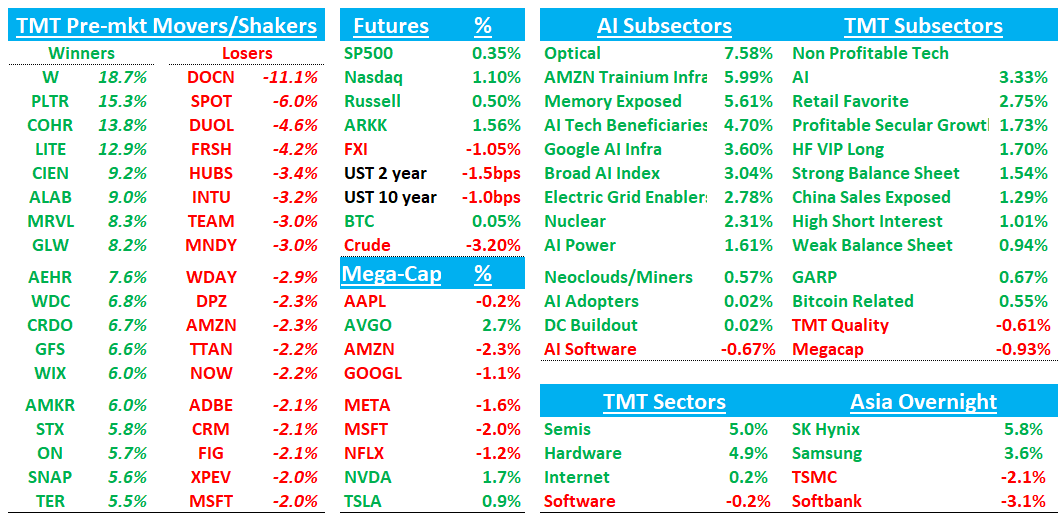
Good morning. QQQs +1% (SPX +35bps) as futures rallying after CNBC reported Bessen said there may be a deal Tuesday or Wednesday to open Strait of Hormuz with “freedom of movement.” Semis being helped by news that Trump banning Chinese optical transciever products which has LITE/COHR/CIEN +10% although some pushback on how feasible it is (we go into it below). Semis +5% as a group while software is flat (although ex-PLTR, down 1%). Hyperscalers giving some back early after a few days of outperformance.
Overnight, Asia was mixed: TPX +0.04%, NKY +0.32%, Hang Seng -0.6%, HSCEI -0.9%, SHCOMP +0.33%, Shenzhen +2.73%, Taiwan TAIEX -0.06%, Korea KOSPI +1.62%. Memory names up with SK Hynix +6% and Samsung +4%.
Things begin to ramp up on the earnings front today. We’ll be here covering it all.
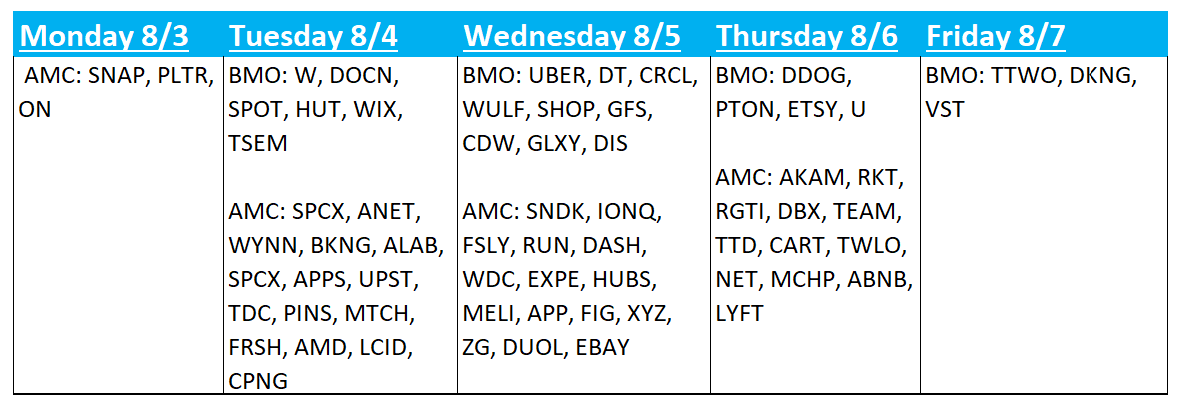
We’ll hit PLTR ON SPOT DOCN TSEM earnings recaps first the onto the usual.
Let’s get straight to it…
PLTR +14%: A U.S.-led blowout, 2nd biggest beat on record, & accelerating revs helps keep accelerating narrative alive.
Stock had been in the narrative dog house and positioning skewed short given some mediocre commercial checks heading in (remember Clev?) so these numbers much better than expected. It’s still unclear to me whether this print shifts the bull vs. bear debate in a material way (see below), but for the day definitely good enough.
Karp gave his usual enthusiastic spiel, positioning PLTR as the sovereign AI control layer for Western enterprises, letting customers orchestrate and fine-tune multiple models while keeping their data, prompts, reasoning traces and model weights inside their own security boundary, reiterating his usual critique of frontier labs saying that enterprises are paying open-ended token bills while effectively handing proprietary know-how to third-party models, whereas PLTR claims it can convert those models into measurable workflows while customers retain ownership of the resulting “alpha.”
Key quote on the growth rate: “I am driving the business to grow at a rate equal or above to what we have in US commercial for the next 18 months, which is a very high goal, but it is one we can actually get to” although on the call back mgmt said that was aspirational and not formal guidance and said said investors should interpret it as targeting 100%+ growth for combined U.S. revenue, said investors should interpret it as targeting 100%+ growth for combined U.S. revenue,
The #s:
Q2 Revenue was $1.936B, +93% y/y (last q +85%) vs Street $1.811B, +~80%; adjusted EPS was $0.41 vs Street $0.34, or roughly $0.39 excluding the $0.02 SpaceX mark-to-market benefit.
US Commercial was $764M, +149% y/y (last q +133%) vs Street ~$716M, +~134%, above the ~135–140% buyside bogey; US Government was $809M, +90% vs Street ~$733M, +~72%
Non-GAAP OM reached 61.7% vs Street 59.6%, adjusted FCF margin was 63.1%, NDR rose to 157%, and US Commercial TCV reached $2.132B, +153% y/y
FQ3 revenue guidance was $2.160–2.164B, +83% vs Street ~$2.000B, +~69%;
FY26 revenue guidance was raised to $8.150–8.158B, +82% vs Street ~$7.722B, +~73%, with US Commercial raised to >$3.424B, +134%+.
Key Takeaways:
AI The new narrative is “sovereign AI”: customers retain control of their data, logic, actions, security, model weights and accumulated institutional intelligence. PLTR is extending AIP into model evaluation, orchestration and post-training through supervised fine-tuning and reinforcement learning, initially including classified deployments with NVIDIA’s open-weight Nemotron models. This positions PLTR above individual models rather than tying its fate to any one frontier lab.
Competition . Mgmt described a head-to-head engagement in which a frontier lab failed to generate value while PLTR’s AIP/FDE deployment converted into a $10M ACV contract. Customer checks also indicate large customers are not currently moving PLTR workloads or planned use cases to AI-native alternatives. The remaining risk is that OpenAI, Anthropic, AWS and MSFT are all investing heavily in FDE-style deployment organizations, while Databricks and Snowflake remain lower-cost alternatives for less complex workloads.
Demand The demand commentary was unusually strong. Mgmt described “massive demand” from CEOs and operating leaders seeking measurable AI returns and greater control over proprietary data, prompts, workflows and reasoning traces. The message was that enterprises are not cutting AI budgets broadly; they are becoming less willing to fund open-ended token consumption without demonstrable ROI.
Growth The growth engine is increasingly installed-base expansion. NDR rose to 157% from 150%, average trailing-12-month revenue from the top 20 customers increased 67% to $124M each, and customers that initially entered through pilots are converting into multi-year, enterprise-wide relationships. US Commercial RDV reached $6.24B, +124% y/y and +27% q/q, providing substantial contracted growth ahead.
Customers The clearest blemish was slower new-logo formation. PLTR added 42 total customers vs 53 last quarter and 80 a year ago, including 38 US Commercial additions vs 44 last quarter. US Commercial customer growth slowed to 35% from 42%, and the 38 additions were the lowest since 3Q24. The positive interpretation is that the customers being added are much larger and expansion is accelerating; the bear interpretation is that the long-term growth model is becoming more dependent on a relatively concentrated installed base.
Government US Government accelerated to 90% from 84% last quarter, driven by existing-program execution and new awards. Maven secured its first program of record that selected Maven as the operating platform for the entire program, its builder ecosystem exceeded 25,000 users, and trailing-12-month Department of War revenue remains less than 25 basis points of the Pentagon budget. That supports the argument that government scale is large in absolute terms but penetration remains very low.
Guide The quarter materially weakened the immediate competition bear case. Mgmt described a head-to-head engagement in which a frontier lab failed to generate value while PLTR’s AIP/FDE deployment converted into a $10M ACV contract. Customer checks also indicate large customers are not currently moving PLTR workloads or planned use cases to AI-native alternatives. The remaining risk is that OpenAI, Anthropic, AWS and MSFT are all investing heavily in FDE-style deployment organizations, while Databricks and Snowflake remain lower-cost alternatives for less complex workloads.
Guide The FY26 revenue raise of roughly $498M was considerably larger than the quarter’s dollar beat, while OM and FCF guidance were also raised. Karp’s 18-month statement was important but should not be treated as formal guidance: the callback clarified it as an aspirational goal for overall US revenue growth to exceed 100%, not a formal commitment for total company growth to remain at the current 149% US Commercial rate. Mgmt also cautioned that the 7.5% quarterly revenue beat is not the new baseline.
Margins Non-GAAP OM expanded to 61.7% from 60.2% last quarter and FCF margin reached 63.1%, showing exceptional incremental economics even as PLTR invests aggressively. Gross margin fell to 86.3% from 87.9% and missed Street by roughly 50 bps because PLTR assumed cloud-hosting costs for a government customer. Mgmt expects a meaningful FQ3 expense ramp from new-hire starts, R&D, product and marketing investments, which explains the modest sequential OM step-down in guidance.
International International Commercial remained at 26% growth, while International Government slowed to roughly 43% from 51%. Mgmt expects international results to remain relatively muted, and European political concerns around dependence on US technology remain a headwind in France, Germany and potentially the UK. This matters less while the US is growing more than 100%, but it limits the breadth of the current acceleration.