


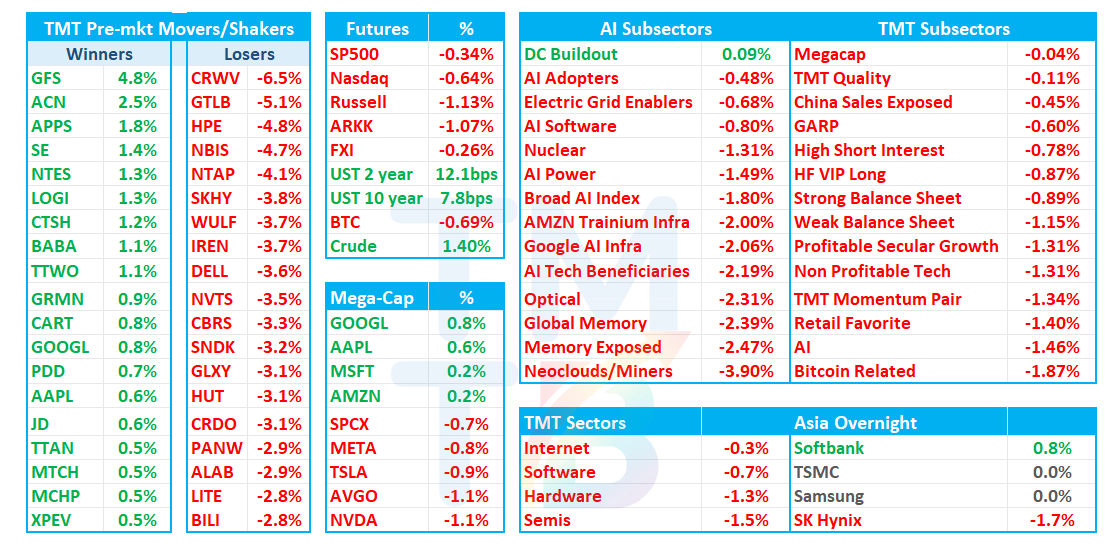
Good morning. QQQs -60bps to start the morning as of 8:35am dipping on a hotter CPI (Core CPI mOM +0.33% vs 0.2%) with yields spiking 7-11bps across the curve and Oil +1% on reports Houthis struck Saudi Aramco HQ & Iran striking tankers in SoH.
In Tech, Semis -1.3% as all eyes on Anthropic’s investor day briefing today. Internet/Software flat. ACN +2% on a positive update at their investor day. ASML flat after a decent set of numbers. CRWV -7% as investors and X focus on spiking bonds yields (‘32 bonds hit 14% yield, below 80c) while CDS almost at 1000bps. Cyber weaker (PANW/CRWD -3%) on OpenAI in early talks to acquire a Cyber co and OAI CFO saying cyber will be a revenue driver next year. GOOGL +1% as Gemini 4 Argon went GA. DELL/HPE -3-4% on a Barclays dg.
Stocks mostly saw losses in Asia on Wednesday: TPX -0.23%, NKY -0.05%, Hang Seng -0.13%, HSCEI +0.1%, SHCOMP -0.88%, Shenzhen -1.81%, Taiwan TAIEX +0.59%, Korea KOSPI -0.44%.
We’ll hit ASML first, then the usual. Let’s get to it…
ASML: Margin-Led Beat/Raise; More 2028 Capacity, but 2027 Plan Unchanged
Q3 revenue a tad light €11.66B grew 55% y/y versus 21% last quarter and street at 11.71, with gross margin of 57.5% versus Street at 56.0% and EPS of €12.93 versus €10.87; Q4 revenue guidance is ~3% above Street, with stronger operating leverage underneath.
Overall, solid numbers despite especially the GM upside, with productivity upgrades driving the margin beat and guidance raise. The bigger positive is that demand now exceeds planned supply in both 2027 and 2028, while higher value-based pricing has been agreed with major customers and starts contributing next year. The near-term limitation remains units: 2027 low-NA capacity stays around 85 tools, below the 90–100 bull bogey, with more meaningful capacity upside pushed into 2028. Bears will point to the systems miss, a small bump of €500M to FY26 revs and say FY27 #s not going to move much.
Key Takeaways
Demand visibility: Orders continue strengthening across advanced logic and DRAM, with substantial EUV ordering for 2028 and customer interest extending into 2029–30. Customers keep raising short- and medium-term equipment requirements, and the previously planned 30% capacity increases in both 2027 and 2028 are no longer sufficient. Importantly, 2029–30 commentary is customer interest, not a disclosed amount of firm bookings.
Capacity ceiling: The 2027 low-NA plan remains ~85 systems, up ~30%, versus Street around 87 and bull expectations of 90–100. The callback clarified that lead times leave little room to materially change the 2027 build plan, although a few additional tools may be possible. There is more flexibility to move 2028 beyond the previously implied ~110 systems through shorter cycle times, high-NA/R&D bay usage, smart testing and supply-chain improvements. No additional cleanroom footprint is planned to address 2028 demand.
Pricing agreed: Major-customer value-based pricing negotiations are complete. Benefits phase in through 2027 and become more fully visible in 2028 as existing volume purchase agreements expire; purchases outside those agreements already face higher pricing. The callback also clarified that this is not simply a parts-price increase: it applies across improvements that add value to the system. The timing is becoming clearer, but mgmt has not provided a quantified company-wide pricing uplift.
Upgrade strength: Installed Base Management (IBM) revenue reached €3.29B, up 68% y/y and 13% above Street, with Q4 stepping up again to €3.7B. FY26 IBM growth is now ~50%, up from ~30%. Customers are paying to extract more wafer capacity from existing tools and cleanrooms, giving ASML an earnings-growth lever that does not depend on shipping additional EUV systems. Software-heavy upgrade mix is the key reason margins are outperforming.
Beat quality: System revenue missed Street by ~5%, with logic ~12% below and memory ~4% above. The upgrade beat offset that shortfall. Reported EPS benefited from a roughly €510M equity-investment gain associated with Mistral AI; the cleaner operating-profit beat was ~5%, with EPS beat excluding investment gains at ~7–8%. Strong execution, but the ~19% headline EPS beat overstates the underlying operating surprise.
Q4 margins: Gross margin is guided to ~57%, down roughly 50 bps sequentially despite higher low-NA EUV, immersion and upgrade revenue. The callback attributes the pressure primarily to more dry-system shipments and capacity-ramp costs; hiring and FX also feature in the initial commentary. High-NA revenue recognition stays at one system in each quarter, rather than a step-up explaining the decline. The guide leaves room for another mix-driven beat, but the ramp costs are real.
DUV nuance: FY26 non-EUV growth was reduced to ~20% from ~25%, even as immersion demand remains strong. Customers that previously ordered EUV tools for new logic and DRAM nodes are now placing the associated immersion orders, which have shorter lead times. Immersion sales rose to 40 systems from 23 in Q2. The distinction is stronger forward immersion demand versus a softer near-term non-EUV revenue forecast, not an across-the-board equipment raise.
China recovery: China revenue increased ~109% q/q and reached 23% of system sales versus 14% last quarter, primarily from logic customers buying immersion tools. The callback sees no material MATCH Act pull-in behind the strength. China revenue is expected to increase again in Q4 and grow in 2027, with incremental demand coming from new CXMT and YMTC memory cleanrooms.
Cash/orders: FCF was approximately €11.4B versus Street at €3.77B, alongside a roughly €6B sequential increase in contract liabilities. That supports the strong-order narrative, although advances are not a substitute for a reported bookings figure. Barclays’ prior €55B+ backlog estimate now looks conservative to the firm, but remains an analyst estimate rather than company-reported backlog.
Product roadmap: NXE:3800F lifts low-NA throughput to 260 wafers/hour from 230, with small initial volumes in 2027 and a larger contribution in 2028; BofA expects only 6–7 F tools next year. New immersion specifications reach 330 wafers/hour, while the EXE:5200C high-NA roadmap reaches 190. Higher throughput supports both customer capacity and value-based pricing, so unit growth alone understates the revenue opportunity.
High-NA/Terafab: ASML recognized one high-NA tool in Q3 and expects one in Q4, taking FY26 to five. The callback analyst forecasts five in 2027 and eight in 2028, versus BofA at six and ten, respectively; these are forecasts, not company guidance. Separately, ASML has Terafab orders and expects pilot-line shipments in 2027, followed by the main fab in 2028–29. Some think the pilot is at TSLA’s Texas Giga campus.
TECH RESEARCH/NEWS
ACN: Investor-day outlook points to faster FY29 growth – Investor day
Ahead of today’s Investor Day, ACN guided to mid-single-digit revenue growth in FY27–28, accelerating to mid-to-high single digits in FY29, with FY29 above Street expectations. Growth will be driven by organic and inorganic investment, with ACN targeting a $3T TAM, 10–30bps of margin expansion over three years, FCF conversion >1.1x, and dividend payouts of mid-to-high 40% of prior-year net income. FY27–28 revenue, margins and FCF guidance are broadly in line with consensus, while dividend guidance is slightly below. Investor Day will focus on the drivers of FY29 acceleration, particularly GenAI’s impact on ACN’s TAM, productivity and risks.
DELL: Barclays downgrades to EW, sees memory-driven growth decelerating despite AI server strength
Barclays says DELL’s AI server business remains strong, with FY27 revenue ~tripling to $75B and potential upside to its $100B FY28 estimate, but much of the enterprise server/storage growth has been driven by higher ASPs from memory inflation rather than a true enterprise-AI inflection. As memory normalizes, Barclays expects materially slower growth and smaller beats. EW from OW, PT $574 from $603.
HPE: Barclays downgrades to EW after strong run, says networking upside now reflected
Barclays remains constructive on HPE/JNPR networking, with FY26–29 networking growth now seen at high-teens and improving AI exposure across campus, scale-up and scale-across. But server/storage strength has also benefited from higher memory-driven ASPs, and Barclays sees less upside as pricing normalizes. EW from OW, PT $77 from $83
NTAP: Barclays downgrades to EW as valuation catches up, despite strong cloud business
Barclays still views NTAP’s cloud business as one of the best in hardware, growing ~20% with 85%+ GM and now ~10% of sales, alongside a high recurring-revenue mix. But after a ~123% YTD run, near-term storage upside is increasingly tied to NAND pricing that Barclays expects to normalize next year.
ABNB: Hearing M-sci raising Q3 GBV estimates on continued nights strength in Sept.
OpenAI: CFO was on BBG TV
Not seeing headlines, but TMTB Slack on it…