


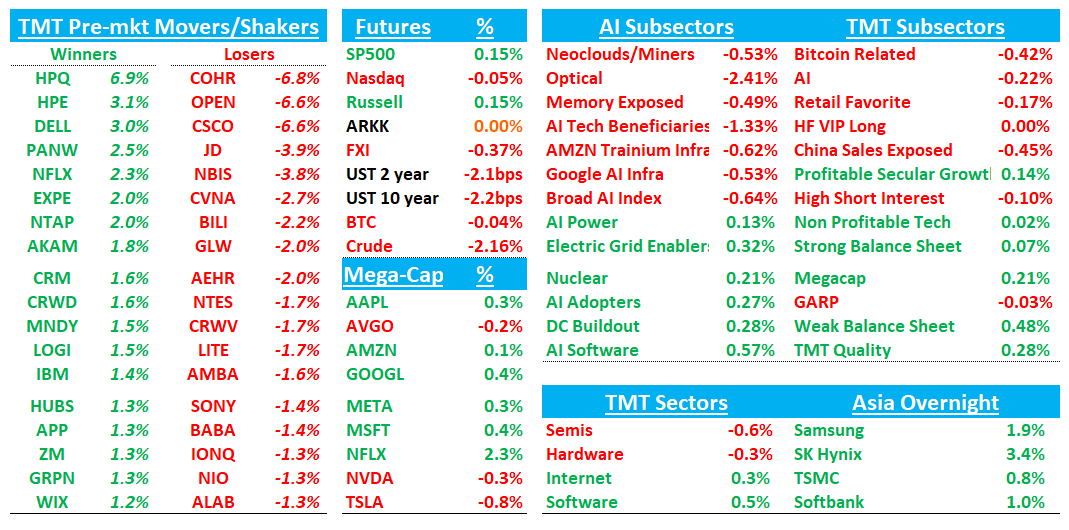
Good morning. Futures flat, Oil -2, and yields ticking down slightly on a relatively quiet August morning.
Asia mixed overnight but Korea finished up: TPX +0.89%, NKY +1.16%, Hang Seng -0.17%, HSCEI -0.23%, SHCOMP -0.5%, Shenzhen -0.97%, Taiwan TAIEX +1.11%, Korea KOSPI +3.56%. Samsung +2%; SK Hynix +3.5%
In tech, semis off slightly while software +50bps. COHR/CSCO -6% on set of decent numbers but some GM nits as well as missing heightened expectations. CBRS -15% after their print. DELL/HPE/HPQ +3-5% on the back of better Lenovo results overnight. PANW +2.5% on a better Clev mention. NFLX +2% on Ackman taking a stake. SNDK analyst day today.
We’ll hit CSCO COHR CBRS and Lenovo earnings first, then onto the usual.
CSCO -6%: Beat FQ4 revenue, EPS and operating-margin expectations and guided FQ1/FY27 materially above Street, with core growth moving to roughly 10% and FY27 hyperscaler AI revenue to $7.5B; the offset is a 65–66% FQ1 GM guide and an expected further step-down in FQ2.
Bulls liked the big numbers (largest beat in 4 years) and 15% FY27 rev guide which was ahead of buyside expects, bear nits are the GM step down, FY27 growth contains large pricing contribution so questions around how much of the 10% core growth is durable and organic enough for op leverage to outpace a multi-q GM reset, and Q4 AI orders only inline to slightly light of buyside expects.
Q2 Revenue: $17.252B, +17.6% y/y (last q +12.0%) vs. Street $16.836B, +14.7%.
EPS / Margins: EPS $1.22 vs. Street $1.17; non-GAAP GM 66.3% vs. 66.0%; non-GAAP OM 35.9% vs. 34.7%.
The $4B of Q4 AI orders beat CSCO’s prior $3.7B target but just inline w buyside bogey
FQ1’27 Guide: Revenue $18.0–18.2B, midpoint $18.1B, +21.6% y/y vs. Street $16.834B, +13.1%; EPS $1.32–1.34, midpoint $1.33 vs. Street $1.16.
FQ1 GM guidance of 65–66% is below Street at 66.2%, and mgmt expects product GM to step down again in FQ2 and remain around that lower level through much of FY27
FY27 Guide: Revenue $72.2–73.4B, midpoint $72.8B, +15.0% y/y vs. Street $69.121B, +9.2%; EPS $5.05–5.11, midpoint $5.08 vs. Street $4.83.
FY27 hyperscaler AI revenue is expected to reach $7.5B, nearly +90% y/y from approximately $4B in FY26, and mgmt expects FY27 orders to be “meaningfully higher” than FY26
Key Quotes:
On Pricing and passing through cost inflation:
“In terms of the price increases as you look at the impact on the financials, it was about 5 points in terms of top-line revenue growth that we saw in Q4... overall, we're sort of planning for that kind of 4 to 5 points of impact this year as well... The prices increases that we do are specific to hardware, not specific to software... But we're doing a good job of passing that price on. I think the customers, while they don't like it, they understand that it's an industry issue, not a Cisco issue.”
On demand:
“As it relates to budgets, what I think is going on, what we're hearing from our customers, is they're currently reprioritizing within their existing budgets. But I would also say that you're beginning to see a trend where our customers are looking at AI readiness, mythos readiness, quantum readiness in a similar vein to how they've looked at cybersecurity spend over the last three to four to five years. It's just not optional.... I think the whole discussion of where the budget comes from is it's not even an issue... they start from the premise of we don't have a choice, and then they figure out how to fund it.”
Key Takeaways
Demand. Product orders remained +35% y/y, but the cleaner signal was ex-hyperscaler growth accelerating to +25% from +19% last quarter. Enterprise orders were +21%, public sector +30%, service provider/cloud +95%, telco above +30% and networking +40%, showing that strength extends well beyond hyperscaler AI. Mgmt said companies are reprioritizing existing budgets rather than pausing projects because AI, security and infrastructure-readiness investments increasingly look non-optional.
Core growth. The largest narrative change is that FY27 core growth excluding hyperscaler AI is now expected to be roughly 10%, materially above CSCO’s old 4–6% long-term framework. The approximately 15% total FY27 growth algorithm comprises roughly five points from pricing, five points from underlying enterprise volume and five points from hyperscaler AI. That leaves the central debate as the durability of volume once pricing begins to lap, rather than whether current demand is real.
AI. Hyperscaler AI orders were $4B in FQ4 and $9.3B for FY26, with a roughly 60% Silicon One systems / 40% optics mix. FY27 hyperscaler AI revenue is expected to reach $7.5B, nearly +90% y/y from approximately $4B in FY26, and mgmt expects FY27 orders to be “meaningfully higher” than FY26. CSCO now has three P200 scale-across wins at three separate hyperscalers, and mgmt estimates AI scale-across traffic is roughly 14x traditional data-center-interconnect traffic. The callback indicated scale-up should not become meaningful until FY28, so near-term AI growth remains primarily scale-out, scale-across and optics.
Enterprise. Data-center networking orders grew more than 35%, campus orders grew 20%, and Wi-Fi 7 represented more than half of wireless orders. Mgmt sees simultaneous switching, routing and wireless refreshes, with AI readiness, cybersecurity, quantum readiness and end-of-support replacement all contributing. Enterprise Nexus opportunities tagged for AI increased more than 85% q/q, while CSCO argued it benefits whether workloads remain in the cloud or move to private data centers and the edge.
Callback. The most important post-print callback takeaway was that only approximately 8% of the campus installed base has been refreshed. Mgmt also saw no meaningful customer inventory accumulation or order pull-forward; telemetry indicated equipment was being deployed faster than six months ago, and the pipeline continued to expand. That directly pushes back on the view that the current order strength is merely speculative buying or the peak of a short replacement cycle.
Margins. FQ4 non-GAAP GM of 66.3% was modestly above Street at 66.0%, but product GM fell 270 bps y/y as hardware mix and memory costs outweighed productivity and pricing. FQ1 GM guidance of 65–66%, midpoint 65.5%, is below Street at 66.2%, and mgmt expects product GM to step down again in FQ2 and remain around that lower level through much of FY27. The dilution is not just hyperscaler AI: enterprise customers are also buying larger, higher-bandwidth hardware platforms without a proportional increase in software attach.
Leverage. The counter to lower GM is unusually strong operating leverage. FQ4 OM was 35.9% vs. Street 34.7%, and mgmt’s FY27 framework implies approximately 35%, which would be a company high watermark. Hyperscaler revenue requires little incremental selling expense, so lower-GM hardware can still be highly profitable: in FQ4, GM fell 210 bps y/y while operating expenses declined 370 bps as a percentage of revenue, allowing OM to rise from 34.3% to 35.9%.
Pricing. Pricing contributed roughly five points to FQ4 revenue growth and is expected to contribute four to five points in FY27, with more benefit in the first half before prior increases are lapped. The increases are single-digit, hardware-specific and targeted toward products with greater memory exposure. Customers understand the increases are an industry-wide component-cost issue, but reliance on price creates a legitimate quality-of-growth debate and could eventually crowd out other enterprise IT spending.
Security. Security revenue was $2.226B, +14% y/y vs. Street $2.051B, making it one of the largest sources of quarterly upside. Organic security products exited FY26 at high-single-digit growth, firewall orders grew more than 30% for a second consecutive quarter, and CSCO has added more than 6,400 customers for its newer security products. However, FQ4 benefited from several sizable, longer-duration on-prem Splunk transactions, so mgmt expects growth to moderate to mid-to-high single digits in FQ1 before improving through FY27. One post-print note characterized FQ1 as low single digits, but the direct transcript supports mid-to-high single digits.
Supply. CSCO reported no significant lead-time issues and believes it has enough supply to meet FY27 guidance even if demand exceeds the current plan. Advantages include direct engagement with TSMC, no merchant-silicon middleman, strategic inventory, advance purchase commitments and its investment in Nanya. The callback indicated the supply chain is positioned to support more than twice FY26 levels; pump lasers were the only identified area of tightness, and even there supply was not described as severely constrained.
Share. Supply availability and Silicon One appear to be supporting share gains. CSCO won new hyperscaler designs in P200 scale-across, G200 scale-out and managed optical fiber networking, with the optical win positioning CSCO as an alternative to an incumbent supplier. A large global bank also ordered 1,000 CSCO smart switches while replacing both a networking and firewall competitor. Silicon One is scheduled to expand across CSCO’s high-performance portfolio through FY29, giving CSCO greater control over silicon, systems, software and its innovation roadmap.
Customer mix. Each of the four largest hyperscalers grew AI orders at triple-digit rates, and $7.5B of FY27 AI revenue would equal roughly 10.3% of company revenue, up from approximately 6% in FY26. Diversification is beginning: neocloud, sovereign and enterprise AI orders exceeded $400M in FQ4 and $1B for FY26, with enterprise accounting for the majority, but these channels remain early relative to the hyperscaler business.
Bull vs Bear Debate
The broader bull thesis is that CSCO has transitioned from a mature, low-single-digit-growth networking vendor into a beneficiary of two overlapping infrastructure cycles. The first is hyperscaler AI, where Silicon One, Acacia optics and CSCO’s willingness to sell silicon, software or complete systems have rebuilt relationships with customers that historically bought little from CSCO inside their data centers. The second is an enterprise modernization cycle spanning campus, private data centers, security, Wi-Fi 7, end-of-support replacement and preparation for AI and quantum-era security. FQ4 materially supports this thesis: ex-hyperscaler orders accelerated to +25%, enterprise orders rose 21%, networking orders increased 40%, and callback commentary indicated only about 8% of the campus base has been refreshed. The cycle therefore appears broader and earlier than a simple hyperscaler order spike.
Bulls also argue that CSCO’s competitive position is structurally improving. Silicon One gives CSCO direct control over silicon, systems and software, reduces dependence on merchant providers and supports both supply availability and faster innovation. Three separate hyperscaler P200 scale-across wins, a G200 scale-out win and the managed optical fiber-network win indicate that CSCO is gaining relevance across several portions of the AI networking architecture. Scale-across may prove especially durable because distributed clusters require dramatically more inter-data-center traffic, and mgmt estimates the traffic intensity at roughly 14x traditional DCI. Enterprise architecture is also favorable: public-cloud adoption drives hyperscaler networking, while open-weight models and on-prem AI drive private data-center networking, allowing CSCO to participate regardless of where workloads run.
The margin model may be stronger than headline GM suggests. Hyperscaler hardware carries lower GM, but it also requires very little incremental selling expense, allowing CSCO to maintain approximately 35% OM while revenue grows 15% and EPS grows about 17%. Security offers another source of upside if firewall momentum, newer product adoption and Splunk cross-selling sustain high-single-digit growth after the one-time benefit from large on-prem transactions fades. Services should also improve as the growing installed base produces support, assessment, security-modernization and AI-readiness demand. Upside to estimates would come from AI order conversion above the $7.5B revenue target, core volume remaining strong after pricing laps, further share gains and GM stabilizing sooner than expected.
The bear thesis is that the growth profile is more cyclical, inflation-driven and hardware-heavy than the headline FY27 guide implies. Of approximately 15% expected growth, roughly five points come from pricing and five from hyperscaler AI, leaving only about five points from underlying core volume. FQ1 growth is guided to 21.6%, but the implied rate for FQ2 through FQ4 is closer to 13% as comparisons become tougher. The $4B Q4 AI order result also merely matched the buyside bogey despite beating CSCO’s public target. If hyperscaler orders remain nonlinear, campus deployments take longer to operationalize or enterprise customers eventually hit budget limits, estimates could peak shortly after the large FY27 reset.
The margin mix creates a second risk. Product GM already declined 270 bps y/y, FQ1 GM is guided below Street, and mgmt expects another step-down in FQ2. Hyperscalers buy little software, security or services, while enterprise customers are purchasing more expensive hardware platforms without proportionately greater software attach. If revenue growth moderates, the operating-expense leverage that currently protects OM becomes less powerful, exposing earnings to the GM decline. At the same time, services revenue was essentially flat, ARR grew only 3.2% and RPO grew 7.4%, underscoring that the fastest growth is coming from lower-GM hardware rather than recurring software.
There are also questions about the durability of security upside and pricing. FQ4 security growth was enhanced by large, longer-duration on-prem Splunk deals and should moderate substantially in FQ1. Pricing is carrying four to five points of FY27 growth, is weighted toward the first half and represents budget dollars that could otherwise have funded incremental units or other IT projects. The callback found no pull-forward or customer inventory issue today, but strategic inventory and advance purchase commitments would increase downside if orders slow. Finally, the stock has already rerated materially: CY27 EV/FCF around 25x versus a five-year average of 16x, leaving less room for execution errors even after the earnings raise.