


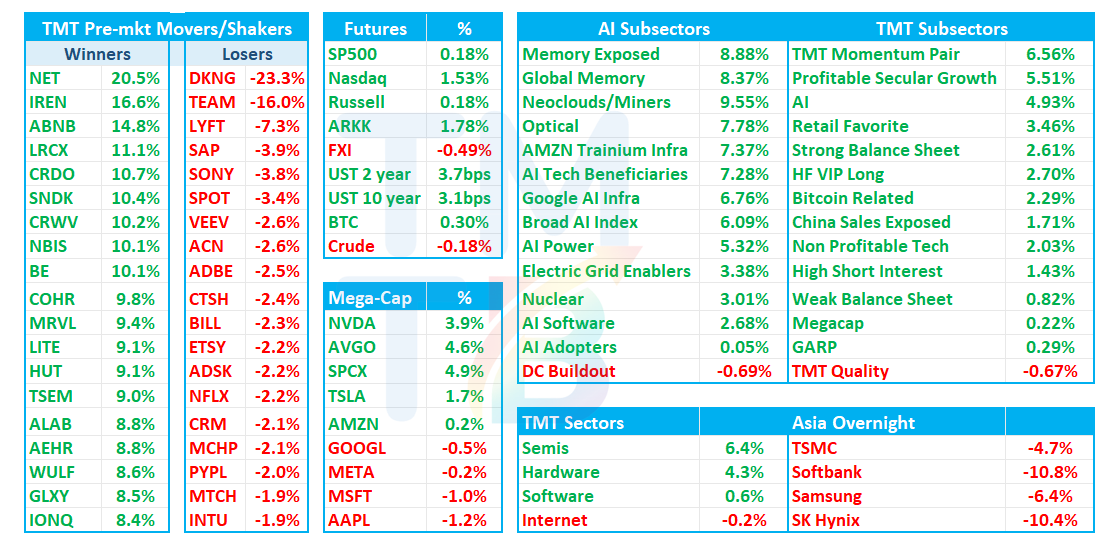
Good morning. QQQs +1.4% (vs yesterday’s -6.5% drop) attempting to bounce after yesterday’s sea of red. Yields +3-4bps across the curve.
Semis +6% (half of yesterday’s 12% drop) leading the way higher. WSJ is out reporting Anthropic topped $80B ARR which is the number AI bulls wanted to see and it couldn’t have come at a better time to stop at least some of the bleeding in front of the likely roadshow next week. The # implies $8B net new adds, and back to the June-July pace. WSJ says “topped $80B” so unclear what the exact number is, but it puts $100B back on the table for Dec (excluding the holiday dip eoy). One # doesn’t solve the debates plaguing the AI trade (and some will question where OAI ended up in Oct?), but looking good enough for some ST reprieve. How much still TBD. Memory +8-10%; Neoclouds +9%; Optical +8% leading the way higher in the space. Hypers underperforming on the flipside: AMZN flat; MSFT -1%; META flat. Hey, even AAPL -1%!

Outside of semis, got some good earnings reports from NET +20% and ABNB +1%, both showing acceleration where it mattered. TEAM -16% less so with the latest sw co to a show a decel earlier than expected. Other app sw names down in sympathy: CRM -2%; INTU -2%, etc.
Overnight, Asia generally followed the U.S. lower: TPX -5.9%, NKY -5.96%, Hang Seng -1.27%, HSCEI -1.13%, SHCOMP -1.1%, Shenzhen -2.25%, Taiwan TAIEX -4.51%, Korea KOSPI -6.02%
We’ll hit NET TEAM ABNB and MCHP Earnings first then onto the usual
Happy Friday! Let’s get to it…
EARNINGS:
NET +20%: Record beat and & acceleration on tougher comps drives one of the best sw prints this season; 38% Q4 guide puts 40% exit revenue in play
For a stock where positioning had come down into the print given the AI sell-off & DDOG print, this is significantly better than expected with 4-handle revenue coming into view sooner than even the bulls had hoped for. The comp gets tougher next quarter, and implied exit rate given an average beat is getting close to mid 40s. The comp then flattens out in Q1, so bulls will be thinking high 40s+ revenue growth is in possible. Despite being expensive and the overall AI trade notwithstanding, we think NET has one of the best narratives in sw and continues to execute well. Pattern of continuing to surprise on the upside and accelerating on tougher comps reminds us of PLTR a couple years ago.
The acceleration was broad: Prince said NET added ~5% of the web since July 1 and growth sped up again in early October. On prepaid usage deals, the CFO said usage drove the beat, “not a concentrated event, but a long tail of events,” which shaped the 4Q guide. The worry going in was a few big AI customers. Asked about AI natives, Prince called the growth “a really broad-based win,” but mgmt didn’t size AI inference within Workers, or give 2027 numbers. Main nit was the lower GM numbers. Asked about Workers’ lower GM, the CFO cited “significantly lower cost to book” and credited Workers with pulling GAAP profitability into 4Q from 2028 at the latest.
Key Takeaways
Callback. The key callback message on guidance is that methodology is unchanged, but mgmt is now deliberately setting guidance closer to the expected outcome after another outsized beat. The CFO foreshadowed this in September, saying that keeping a tight range means “you have to shift the midpoint”, so the Q4 guide carries less cushion than prior guides. Mgmt described growth as additive layers on an improving GTM core. Publisher/AI-crawler Bot Management came first (late 2025), then the developer platform over the summer, then security most recently. Security skews to traditional products like WAF, but it is also pulling SASE migrations forward by a year or more, especially in FS and government. Mgmt cautioned against over-reading total RPO given duration and pointed to cRPO, a record ACV quarter and cohort strength instead. PoF was a low-double-digit share of new ACV (vs. ~20% in seasonally strong Q4’25). Mgmt said consumption reflects customers using what they bought, not poor capacity planning, and that there is no concentration in a handful of AI names. On the developer platform, revenue from paid conversions is still small and the enterprise benefit lags. NET is the preferred platform for leading vibe-coding vendors, though mgmt conceded some may be transient, and large banks, healthcare and government customers are now building on Workers. On Act 4, the OpenAI pilot materially exceeded expectations and is becoming a product, and other frontier labs want the same.
Demand. Revenue grew 39% (last q +36%) vs. Street +31%, the fastest in ~4 years. Net new revenue was $86.5M q/q vs. $56M in Q2 and $50M a year ago. Every large-customer cohort ($100K to $5M+) posted record y/y net adds, and the $5M+ cohort nearly doubled YTD. Paying-customer adds hit 158K (vs. a ~80K record in Q2). US revenue grew 44% and international 34% (vs. 31% last q). Mgmt also said web adoption stepped up again in early October and that NET added ~5% of the entire web since July 1 (see quote 1).
Guide. The Q4 revenue guide of $845–846M (+38% y/y) is ~6% above Street ($796M, +~29.5%). It implies only ~1.6pts of decel on a ~3pt tougher comp, so the 2-year stack still accelerates (~71% vs. ~70% in Q3). FY26 revenue was raised ~$96.5M to $2.9635B at the midpoint (+37% vs. Street $2.869B), ~2.1x the $46M Q3 beat. Q4 OI of $156–157M (~18.5% OM) and EPS of $0.43 are ~8% and ~13% above Street. A ~3% beat would put Q4 at ~42% growth, and a Q3-like 5–6% beat would put it at ~44–46%. However, mgmt has flagged that PoF mix makes Q4s seasonally bigger and Q1s smaller (Q1’26 net new revenue was just ~$25M). GAAP profitability is now expected in Q4, ~2 years ahead of the Investor Day target of “2028 at the latest”. By our math this is a net-income milestone carried by ~$45M a quarter of interest income, and GAAP operating income likely stays negative.
Consumption. Variable revenue (est. mid-teens % of revenue) drove the upside. A long tail of customers either joined PoF or burned through commitments faster, then renewed early into larger PoF deals. Workers is a big component of almost every PoF deal and gets adopted after signing, which then pulls through SASE and other products. That flywheel lifted DBNR to 122% (last q 120%, year ago 119%) vs. Street ~119%, a ~4-year high. Mgmt said it has “higher ambitions” for NRR, with the largest cohorts growing fastest.
Security. Security is the newest accelerant. AI-assisted research is surfacing critical bugs fast: six of the “worst internet security bugs of all time” came out in under 14 days. That included the Oct 21 PHP flaw, which NET’s WAF started blocking ~9 hours before disclosure. NET sits in front of 20%+ of the web, so nearly every frontier lab and security firm discloses to it early, and it protects free and paid users before bugs go public. Mgmt says banks, government and less tech-savvy buyers are now signing major contracts. It expects the elevated threat backdrop to last ~two years and said security is playing a “heavier and heavier role” in NRR. Win rates vs. Gen-1 Zero Trust vendors improved, as agent identity pulls CISOs into developer-platform meetings. Three of seven highlighted wins displaced Gen-1 SASE vendors, including a $10.3M, 5-year deal with a cabinet-level federal department, which is a negative read for incumbents like ZS.
AI. Developers on the platform reached 10M+ in October (7.4M in June; doubled YTD). Prince now takes “the under” on his Q2 call that agents will outnumber humans online 1,000:1 within five years. He repositioned NET as “the first agentic cloud” rather than a neocloud or a fourth public cloud. His argument is that isolate-based Workers scale densely and globally at costs that container-based hyperscalers and neoclouds can’t match. AI wins included a one-year $11M Workers PoF with an AI company whose users have built tens of millions of AI-generated apps on Dynamic Workers. Meta is scaling its Muse agent on NET, and a Fortune 100 cloud-infrastructure provider signed $15.5M of Magic Transit (network-level DDoS protection) to protect its AI build-out. Mgmt framed AI’s biggest effect on NET as indirect (AI finding vulnerabilities) rather than AI-native spend.
Act 4. NET booked its first Act 4 revenue, led by OpenAI paying for crawl “hints” that flag when pages change, so it doesn’t re-crawl the whole web. Mgmt expects other AI companies to follow and sees agent micropayments and ad-supported agent access as the next models. Prince said Act 4 could become NET’s largest business 10 years out but gave no timeline or sizing.
Margins. Non-GAAP GM of 72.4% (-70bps q/q, -290bps y/y) missed Street (~73.3%). GM is falling again after Q2’s first sequential uptick in eight quarters, despite the CFO saying in August it would “stabilize around the level we have”. The drivers are Workers mix (lower GM but far lower cost to book) and rising third-party infrastructure costs. OM still hit a record 17.5% (+370bps q/q, +220bps y/y), as opex fell 510bps y/y to 55% of revenue (S&M 35%, R&D 13%, G&A 7%) on the Q2 restructuring and AI-driven productivity. The CFO credited Workers growth for both the OM expansion and the earlier GAAP profitability, and said NET is “far ahead” of its Rule-of-50 trajectory. GM is still inside the 70–77% long-term range set at June’s Investor Day, alongside a 30%+ long-term OM target. SBC rose 45% y/y to 22% of revenue.
Backlog. RPO of $2.877B grew 34% y/y (+5% q/q), down from 38% and ~0.3% below Street. Implied RPO bookings growth slowed to ~27% from ~42%. cRPO (65% of RPO) accelerated to 37% (from 35%) and was ~1.5% above Street. Implied cRPO bookings accelerated to ~44% and current billings grew ~38%. Faster PoF burn and shorter contract duration mechanically depress total RPO, so cRPO and ACV are the better gauges. Still, more of NET’s growth now rides on consumption rather than contracted backlog.
Concentration. Mgmt repeatedly rejected the idea that growth is concentrated in a few AI natives. The beat came from a long tail, strength spans FS, government, manufacturing, healthcare and e-commerce, and the CFO cited “no concentration.” Large ($100K+) customers are 75% of revenue (73% a year ago), and the bigger the cohort, the faster it grows. So the rising exposure is to large PoF customers with variable usage, not to any single AI account.
Bull vs. Bear Debate
The bull thesis is that NET has become one of the rare scaled infrastructure platforms where several independent growth drivers are compounding at once, on top of an improving GTM engine. Application services re-accelerated as publishers and enterprises moved to control AI crawlers from late 2025. Workers is becoming a default runtime for AI-built apps and agents from mid-2026, with Workers revenue estimated to be compounding 30–40% q/q this year. Security now has an outside catalyst, as AI-discovered vulnerabilities push even non-technical buyers onto a network that sits in front of 20%+ of the web. Bulls see these drivers as additive rather than sequential, and see PoF as what converts them into revenue. A customer signs one commitment, its developers find Workers inside it, usage burns through the commitment, and the customer renews early into a bigger one; that is the pattern that took NRR from 118% in Q1 to 122% now. Bulls see the advantages as structural. NET runs one programmable network across 340+ cities with every service on every server, so new products ride existing capex. Its isolate architecture is, in bulls’ view, inherently cheaper than containers for bursty agent workloads. Its free tier converted a record ~158K paying customers this quarter. And its trusted-intermediary position with frontier labs, researchers and publishers gives it early warning on threats and a seat at the table in setting the economic rules for agents.
This quarter checked nearly every box. The beat was the largest in company history and broad: long tail, every large cohort at a record, no AI concentration. Mgmt built that run-rate into the Q4 guide instead of discounting it, and cRPO and implied cRPO bookings accelerated. OM hit a record despite GM pressure, the clearest evidence yet that Workers dilutes GM but not unit economics, given its far lower cost to book. GAAP profitability arriving ~2 years early, an operator who scaled Splunk’s sales org succeeding Mark Anderson, and the first Act 4 dollars (with OpenAI paying) all lowered perceived risk. Bulls see three paths to higher estimates and a higher multiple. First, a normal Q4 beat delivers a 40%+ exit rate and pushes CY27 Street from ~$3.9B toward $4B+. Second, NRR has room into the mid-120s as PoF goes from a low-double-digit share of new ACV to a standard part of every deal. Third, security and Act 4 extend the duration of 30%+ growth, which is what a premium multiple actually pays for. Bulls also argue a slower data-center build-out helps rather than hurts, since scarce capacity raises the value of a network that is already built, dense and efficient. And in a software market where 30%+ growth at $3B+ scale is nearly extinct, NET’s scarcity premium should widen.
The bear thesis is that NET’s acceleration is increasingly a consumption story built on catalysts with limited shelf lives, but priced as if it were durable subscription growth. Variable revenue (est. mid-teens % of revenue) drove the beat, and customers burning through PoF commitments faster pulls renewals and revenue forward. Total RPO growth slowed to 34% from 38% (implied RPO bookings ~27% vs. ~42%) even as revenue accelerated, so less of the growth is contracted. Two of the three accelerants are time-bound by mgmt’s own description. Mgmt expects the vulnerability wave to be bad “for, I think, two years”, and the developer surge leans on AI app builders and vibe-coding platforms that mgmt concedes may be transient. Many of the 158K new paying customers are small developer accounts; mgmt’s own example was a ~$5/month app. Structurally, bears point to margins and competition. GM is down ~290bps y/y to 72.4% and did not stabilize as the CFO suggested in August, and the long-term GM floor was already lowered to 70% in June. Capex is at the top of its range and will rise with compute, and FCF margin is ~10% vs. 13% a year ago. Every workload is contested. In compute, NET faces hyperscalers (Lambda, CloudFront and Shield; Azure Front Door; Cloud Run and Cloud Armor) and developer platforms like Vercel. In CDN/WAF it faces Akamai and Fastly, and in SASE it faces Zscaler, Palo Alto and Netskope. In Act 4, the AI labs NET hopes to charge have the scale to build their own crawling and payment rails.
This quarter gave bears specific ammunition behind the headline. Mgmt said it is now guiding closer to the expected outcome, so the ~5–6% beats that have powered the stock are unlikely to repeat at that size. PoF seasonality (bigger Q4s, smaller Q1s; Q1’26 added only ~$25M of net new revenue) sets up a potentially awkward Q1’27, just as CY27 expectations reset from ~29% to ~32%+ growth. Quality-of-earnings flags are building. SBC grew 45% y/y to 22% of revenue, and GAAP EPS of -$0.10 missed Street (-$0.04). Q4 “GAAP profitability” will come at the net income line, supported by ~$45M a quarter of interest income on cash raised largely through 0% converts, while GAAP operating income likely stays negative. The President of Revenue transition also lands just as mgmt plans to change the sales model (more forward-deployed engineers, new SE:AE ratios and technical overlays), a classic source of first-half execution slippage. The multiple would compress on any sign that consumption normalizes (NRR back below 120%), a pause in the AI-app and agent build-out, or a broader rotation out of high-beta AI winners. The stock already fell ~34% from its October high into the print on data-center and AI-trade worries. At ~28x CY27E EV/sales and ~155x CY27E EPS, bears point to NET’s ~80% peak-to-trough drawdown in 2021–22 as the template for what happens when a peak multiple meets slowing growth.
TEAM -17%: Cloud Acceleration Ends: A Smaller Cloud Beat and a 3.5-pt Q2 Decel Guide Overshadow Strong Bookings
Positioning had come down here, but a weaker print overall with the smaller Cloud beat/decel the main nit as it came earlier than even some bears had expected and mgmt didn’t do a convincing job on the call explaining the reasons why. Cloud’s 30.5% missed the ~31.5-32% bogeys and was its first deceleration in six quarters. The ~27% F2Q guide sits 3.5pts below it (vs. 2.3pts in August). Asked about the $33M Data Center beat, the CFO said hybrid migration deals meant “slightly more revenue on data center and slightly less on cloud.” Mgmt tied the guide to lapping the DX acquisition, tougher 2H comps and a “thoughtful and prudent approach,” said part of the Data Center beat was pulled forward, and didn’t size the hybrid hit (asked directly) or DX.
Asked if AI coding shrinks Jira’s role, Cannon-Brookes said its coordination value is “even stronger than it has been in the past.” Nobody asked about margins, so bears will also lean on the implied 2H: ~$855M of operating income (the FY27 OM guide less F1Q and F2Q) vs. Street’s ~$934M. Some things for bulls to point to: Overall, worse than feared and not much for bulls to hang onto here: RPO +44%, cRPO accelerated to +28%, $10K+ cloud customers re-accelerated to +13%, FCF was $463M (26% margin) and non-GAAP OM was 32.5% vs. Street ~28.5%. But overall, not good enought in a tape selling software decels.