


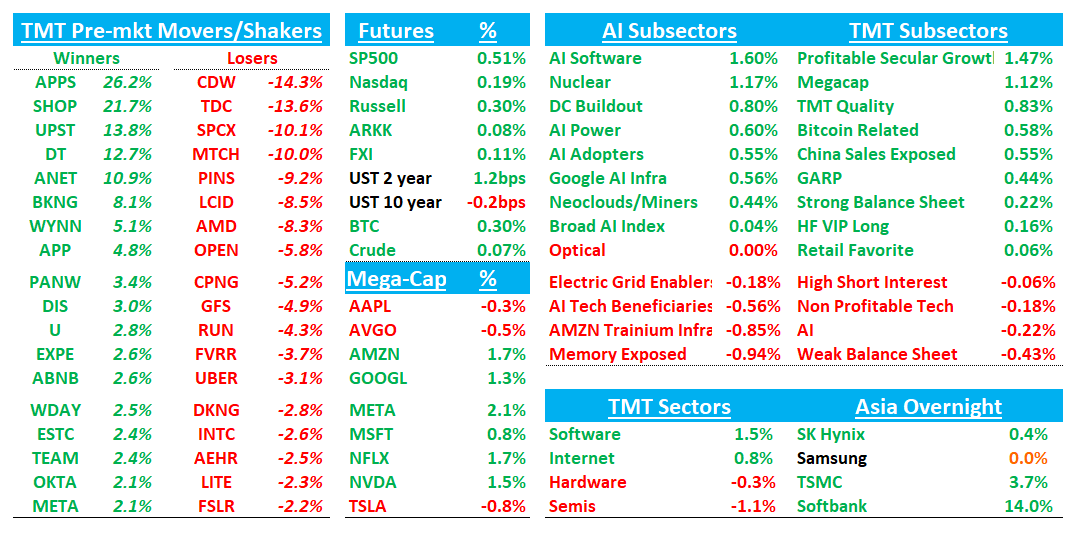
Good morning. QQQs +20bps (SPX +40bps) as stocks look to continued recent rally. Overall, not much on the macro front overnight.
In Tech, Semis -1% and Software +1.5% as AMD -9% disappointed on NT numbers while Lisa did her best to keep investors focused on ‘27 and beyond. SPCX -11% weaker on higher capex and ahead of the lock-up; Elon did a better job for NVDA +1.5% and META +2% on the call, raising ‘27 GW ambitions to 10GW and saying they are an exclusive NVDA shop, while saying compute payback is 1 year, which has investors wondering why META doesn’t turn on that rev spigot immediately. SHOP +22% and ANET +11% crushed and guided above, BKNG +9% better than feared, ALAB -1% crushed but LT questions remain.
We’ll cover SPCX AMD ANET ALAB BKNG and SHOP below then onto the usual.
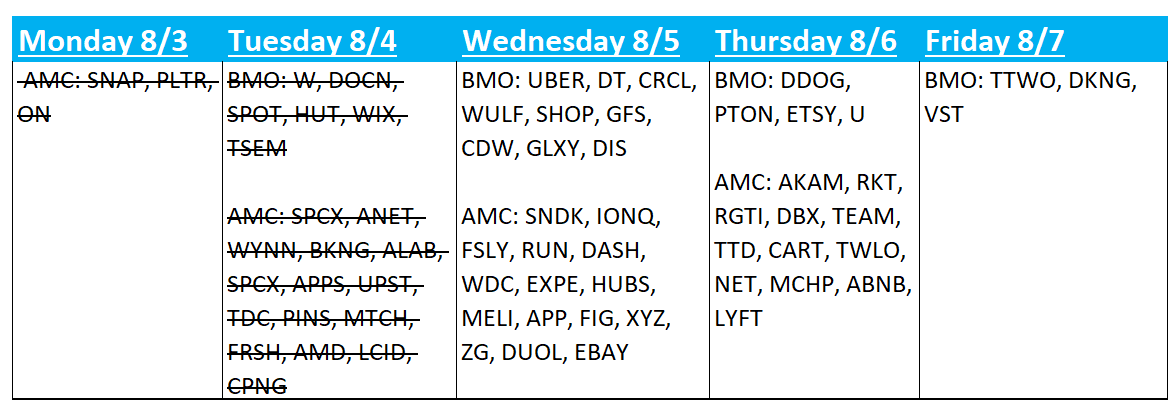
Another busy one after the close today:
Let’s get to it…
SPCX: Big AI-led beat and pulled the revenue curve forward by roughly a year as Elon talked up compute ROI but higher capex and upcoming lock up weighing on the stock
Musk with interesting datapoints during this call. He said SPCX is an NVDA exclusive shop as he thinks Rubin Ultra is the best machine — no ASIC build = higher priority from Jensen. He also said he is ramping FY27 capacity to 10GW, implying 5+GW of new capacity (street at 3.7GW), implying something on the order of ~$300B for AI Capex, depending on what $B/GW assumption you use, and an open question remains where that $ will come from.
Here he is on compute payback:
"The current economics have translated into a less than one year payback on our new capital deployments for compute. For example, in the first few weeks of the third quarter, we've already contracted an additional $6.7 billion of cloud services revenue over a six month period that begins ramping starting in October of this year. We believe this puts us on a trajectory including contribution from Cursor to reach 100 billion of RR, or annualized revenue run rate, by the end of this year, based on our expected revenue in the month of December of this year"
One would think this would be good for META’s compute ambitions…
On Memory:
“Limiting factor currently is memory. Memory output is increasing by around 20% per year. Now normally that would be fantastically fast and amazing for any large mature industry. But ask yourself is the demand increasing by 20% a year? No, the demand is increasing by 200% a year, maybe higher. So if you’ve got demand increasing much faster than supply then Economics 101 would suggest that the price increases. It does not decrease.”
SPCX IPO Lock-Up Expirations
Date | Shares Unlocked | Value | % of SpaceX Market Cap
8/6 | 911.5M | $123.1B | 7%
8/20 | 319.0M | $43.1B | 2.5%
9/9 | 319.0M | $43.1B | 2.5%
9/10 | 59.1M | $8.0B | 0.5%
9/24 | 328.4M | $44.3B | 2.5%
The #s:
Revenue $7.814B, +91.9% y/y (last q +15.4%) vs Street $6.819B, +~67.5%; Adj. EBITDA $3.538B, +191% y/y, 45.3% margin vs Street $2.046B, 30.0%.
AI revenue $2.561B, +247% y/y and +213% q/q vs Street $2.016B, while AI Adj. EBITDA inflected to $1.146B vs Street $65M
Q2 capex was $18.4B, including $15.8B for AI compute, and mgmt said Q3 and Q4 should be “very similar.” vs Street at roughly $13.0B and $13.7B, respectively.
Outlook Mgmt expects more than $100B of total-company annualized December revenue, over 2GW of compute by YE26 and closer to 10GW than 5GW by YE27, but Q3 and Q4 capex should each be similar to Q2’s $18.4B.
Key Takeaways:
Run-rate SPCX signed another $6.7B six-month cloud-services agreement that begins ramping in October, and mgmt expects this deal, existing contracts, Connectivity growth and Cursor to put total-company annualized revenue above $100B in December. This is not traditional software ARR; it is December monthly revenue annualized. Mgmt characterized $100B as effectively a floor, and the sell-side translation is low-$20Bs of Q4 revenue vs pre-print Street at $16.5B.
Compute Nameplate compute reached 1.4GW from 1.0GW last quarter and 0.4GW a year ago. Mgmt expects more than 2GW by YE26 and “closer to 10GW than 5GW” by YE27, well above pre-print assumptions around 4.2GW. SPCX is targeting a 20GW power, cooling and electrical project funnel, while acknowledging that roughly 15GW may actually be available if one-quarter of projects slip.
Returns Mgmt’s defense is that new compute deployments currently have a payback of less than one year, making AI capex closer to rapidly monetized capacity than conventional long-duration infrastructure. Q2 FCF of roughly -$14.9B was actually better than Stree
Grok Grok 4.5 token consumption tripled immediately after launch, Grok 4.6 is expected shortly, Grok 4.7 three to four weeks later and Grok 5 by year-end. Grok 5 will incorporate SPCX’s full data corpus, while mgmt expects only roughly 10% of total compute to be reserved for Grok training over time, leaving the majority available for third-party training and inference. Cursor is expected to close soon and is included in the December run-rate framework.
Semis SPCX is standardizing exclusively on NVIDIA Vera Rubin, expects a “very significant percentage” of NVIDIA’s 2027 GPU supply and plans to use an optimized NVL72 design both terrestrially and in Starmind orbital systems. Mgmt also argued that memory output is growing roughly 20% annually against demand of 200% or more, implying continued tightness and higher rather than lower pricing.
Starlink 1.7M net adds vs 1.4M last quarter, 12.0M subscribers and ARPU stable sequentially at $66. Most of the upside came from enterprise and government, where revenue grew 108% y/y, SPCX won more than $6B of U.S. contracts and aviation remains less than 10% penetrated. Mgmt said it has never lost an enterprise customer and ultimately expects enterprise revenue to substantially exceed consumer revenue
Mobile Starlink Mobile could become another enormous TAM, but also another source of capex uncertainty. Mgmt framed the next-generation system as roughly 100 times better, combining 65MHz of EchoStar spectrum vs 5MHz today with roughly 10 times more satellites. SPCX also confirmed that it intends to build a U.S. terrestrial layer, potentially using small base stations attached to existing Starlink installations, but declined to quantify the investment.
V3 Mgmt’s Starlink thesis rests on a nonlinear capacity step-up: V3 satellites are expected to offer more than 10 times V2 capability, and SPCX expects to launch roughly 10 times as many. However, service will not inflect immediately; mgmt said it needs approximately 1,000 V3 satellites, likely around Q2’27, before customers see a meaningful improvement
Starship Flight 13 materially improved technical confidence. Mgmt said the heat shield appears robust and later described the heat-shield problem as “solved,” with no visible technical obstacles to full and rapid reusability. Flight 14, tentatively at the end of August, could attempt a tower catch and will be the first operational deployment of V3 broadband satellites. The one-flight-per-day target within roughly a year remains highly aspirational, but a successful catch is the next major non-AI catalyst.
Bull vs. Bear Debate
The bull case starts with the idea that AI infrastructure has moved from speculative optionality to an operating business with contracted demand and exceptional incremental economics. SPCX generated $1.6B of incremental AI-infrastructure revenue in Q2, turned AI Adj. EBITDA positive at $1.1B, signed another $6.7B six-month agreement and claims current compute capex pays back in less than one year. If SPCX can repeatedly convert power and GPUs into contracted revenue faster and more cheaply than conventional data-center operators, the current spending is not a cash sink. It is the inventory build for an unusually high-return manufacturing and infrastructure model. Exclusive access to Rubin, a significant share of NVIDIA’s 2027 supply and a 15GW to 20GW power funnel would reinforce the time-to-power advantage.
The broader bull case is that AI, Starlink and Starship reinforce one another rather than operating as separate businesses. Starlink provides recurring cash generation and a growing enterprise and government franchise. Starship lowers launch costs, enables much larger V3 and Mobile constellations and eventually makes orbital compute feasible. AI and robotics then increase bandwidth demand, while SPCX’s launch and satellite capabilities let it deliver the network at structurally lower cost. This quarter strengthened that flywheel: Starlink added a record 1.7M subscribers, enterprise and government grew 108%, Flight 13 improved confidence in reusability, and V3 deployment is moving from concept toward an operational launch.
The bear case is that Q2’s AI upside came from short-duration capacity-offload agreements priced during an acute compute shortage, not from a durable cloud or software franchise. Some contracts preserve customer cancellation options after an initial period, and mgmt’s $30 to $50 per-watt monetization framework may normalize as Rubin supply, power availability and competing capacity expand. Even a modest decline in price per watt matters enormously when SPCX is spending roughly $18B per quarter today and potentially well over $100B annually in 2027. The less-than-one-year payback is a point-in-time claim; if utilization, contract renewals or pricing disappoint, the same capex can quickly become a large stranded-cost problem.
The rest of the portfolio still requires major execution. Starship’s heat shield may look solved, but full reuse, daily cadence, regulatory approvals and dependable payload deployment remain unproven. V3 does not materially improve Starlink service until roughly 1,000 satellites are deployed, which pushes the key capacity inflection into 2027. Consumer Starlink KPIs were mostly in line, blended ARPU is already down 22% y/y, and the quarter’s Connectivity upside was concentrated in government and enterprise contracts. Mobile adds another very large TAM, but SPCX has not quantified the terrestrial-network investment. Add the near-term lockup supply, and bears can argue that the operating story improved without reducing the stock’s financing, execution or duration risk.
AMD -9%: AMD delivered a clean beat/raise vs. streetand materially raised the 2027 Data Center earnings framework and blessed buyside ‘27/’28 #s, but near-term guide missed an elevated buyside bar, particularly on GM and the implied AI GPU ramp.
Stock leaned long into the print and had outperformed semis leading up to their AI day/Anthropic announcement, but #s missed high expectations going in. Lisa tried to keep the focus on Q4/’27 and beyond ramp, essentially seemingly blessing higher than street numbers, but bulls will be disappointed that NT #s weren’t higher.
Buyside numbers likely unchanged after yesterday for FY27/FY28 with most sitting in low 20s/$30, respectively. We don’t think the print does anything to change the medium/long term CPU + GPU bull case, but unclear if this going into the funding short camp NT given lack of catalysts until we get closer to next earnings as Helios inflection begins at end of Q3. It wouldn’t surprise us if somewhat range bound, unless the whole group breaks out with low end at low $20s x 20 = $400-$440. Bulls will keep their LT framing as 25x+ on FY28 #s ($30) = ~$750. Risk/reward still seems pretty solid here.