


Good morning. Futures +1.4% bouncing back early after Friday’s 4.8% decline. Semis +4% leading the way higher early after being down 10% on Friday, biggest decline since the early 2000s. MRVL +8% and FLEX +4% leading the way up early after being added to SP500. Memory names strong with MU +6.5% and SNDK +4%
Crude +1.4%. Yields flattish. Asia mainly down off the U.S. weakness Friday: TPX -2.45%, NKY -3.85%, Hang Seng -1.22%, HSCEI -1.13%, SHCOMP -1.7%, Shenzhen -3.14%, Taiwan TAIEX -3.48%, Korea KOSPI -8.29%
AAPL WWDC scheduled to kick off at 1pm ET where investors want to see the progress they’ve made on AI platform and agentic vision.
Lots to get to this morning, so let’s get right to it.
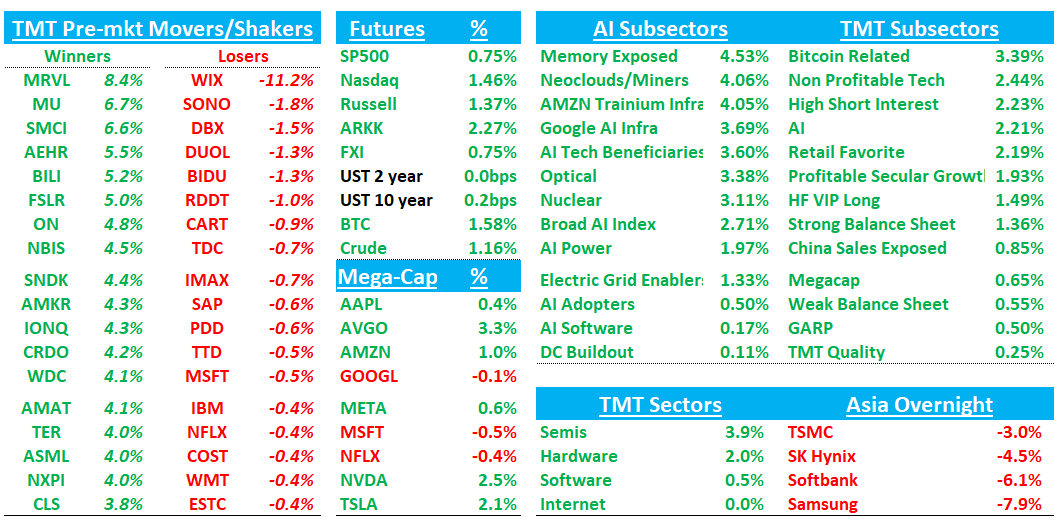
MRVL / FLEX: Set to join SP500
ROKU: Set to join S&P Midcap400
OpenAI: OpenAI plots biggest ChatGPT overhaul since launch
FinancialTimes:
The company intends to transform the chatbot into a “superapp” that combines coding tools and AI agents, adding products that executives believe will generate more revenue. The changes are part of a broader reorganisation at OpenAI as the San Francisco-based company shifts resources into trying to win lucrative business customers and compete more fiercely with rival Anthropic, according to more than a dozen current and former employees.
The overhaul, which is set to begin rolling out in coming weeks, will initially appear as changes to ChatGPT’s website and mobile apps, encouraging customers towards using coding, image-generation and apps from external partners.“Chat is dead,” said one senior OpenAI employee.
OpenAI: Trump administration, OpenAI discussing possible government stake in the AI startup (Out Friday)

Semafor/CNBC:
OpenAI CEO Sam Altman and the White House are in ongoing talks about a possible government stake in the artificial intelligence company, CNBC confirmed on Friday.
The discussions have been in progress for more than a year, as Altman first shared the idea with the Trump administration in 2025, according to a source familiar with the matter who asked not to be named because the details are confidential.
The talks continued this week as Altman met with a range of lawmakers and officials in Washington about regulation and the latest developments in AI.
As part of the potential agreement, OpenAI could donate equity to the U.S. government to seed something like the “Public Wealth Fund” that the company outlined in its April policy proposal, the person said.
NOTUS first reported Altman’s pitch, which the president told reporters Friday he might discuss with “all the big” AI firms as soon as this week: “The American people can benefit from the success of AI, and by doing that, they’re going to like it better,” Trump said.
INTC: GF Securities Raises PT to $135, Sees Significant Foundry Capacity Upside and Improving Yield Trends
GF Securities raised its PT on INTC to $135 from $94, citing improving 18A yields, stronger server CPU demand, and growing confidence in Intel Foundry’s capacity expansion plans. The firm now expects Intel 3 capacity to increase ~80% and 18A capacity to double between 2026 and 2028, supported by external foundry customer commitments and improving manufacturing execution. GF also highlighted Clearwater Forest as a meaningful server CPU catalyst, with production expected to begin in 3Q26 and drive stronger DCAI growth through 2027. The analyst views potential collaboration with NVDA on x86-based PCs, server CPUs, and foundry services as incremental upside rather than a core part of the thesis.
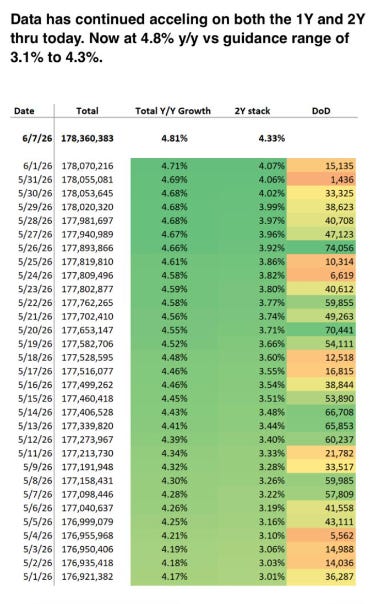
VRSN: Data continues to accelerate
AI Infrastructure: Bernstein Estimates Vera Rubin NVL72 Costs ~$9.1M per Rack and ~$47B per GW
Bernstein updated its Vera Rubin NVL72 cost model and now estimates a fully configured rack costs roughly $9.1M, above widely cited ~$8M figures, driven primarily by higher memory and storage costs. The firm estimates GPUs remain the largest cost component at roughly $4M per rack, while networking contributes another ~$1.2M and memory/storage approximately $3.2M. On a datacenter basis, Bernstein estimates all-in AI infrastructure capex of roughly $47B per GW, including both IT and physical infrastructure. Despite higher costs, the firm argues Rubin continues to deliver improving performance-per-dollar, with major increases in compute density, memory content, networking, power, and cooling requirements.
MEMORY
Memory: Citi Says Rubin SoCAMM Reduction Reflects Supply Constraints, Not Demand Weakness and positive for NAND demand
Citi believes Nvidia’s decision to reduce Vera Rubin SoCAMM2 capacity by moving from 192GB to 96GB modules is being driven by industry-wide DRAM shortages rather than weaker demand. While the change cuts DRAM content per rack, the firm expects no meaningful reduction in overall SoCAMM demand as memory suppliers remain capacity constrained and Nvidia prioritizes shipment volume. Citi also argues the move reinforces the need for larger KV-cache memory pools, increasing the importance of Context Memory Extension (CMX) architectures. As a result, the firm sees the adjustment as neutral for DRAM demand and potentially positive for NAND demand over time as CMX adoption expands.