


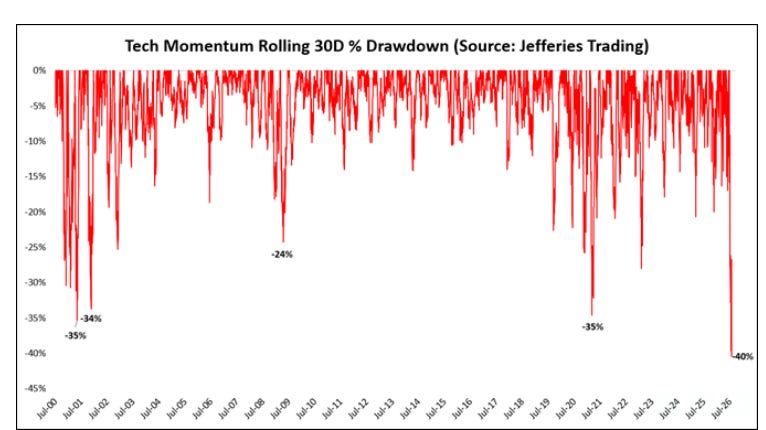
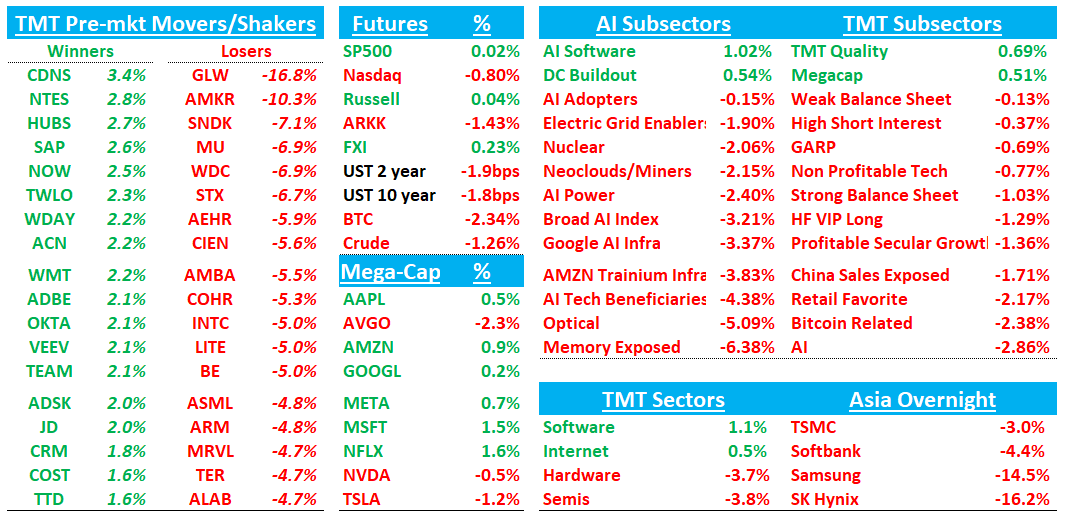
Good morning. Tech Futures -80bps (SPX flat) as the AI Semi unwind continues with semis -4% early. Korea had their 4th worst session overnight ever with KOSPI finishing -8% and triggering circuit breakers during the session — it’s on pace for its worst month in over 30 years with memory names taking the brunt of the pain last night (Hynix -16%; Samsung -15%; Kioxia -18%). US names following earlier with SNDK/MU/WDC/STX -7% early. Many other names down 4-5% as momentum looks to take another hit early. Good chart from our friends at Jefferies showing the magnitude of the momentum unwind, the worst going back to 2000:
Software +1% benefiting from the unwind again early. Not much new to call out for the sell off with the familiar culprits being cited (more muddied AI semi narrative, momentum/leverage unwind, credit/equity issuance digestion, weaker price action earnings.) Big volume in SMH yesterday with puts outweighing calls by nearly 5 to 1. We had some thoughts on the current trading environment/narrative/setup in our EOD wrap yesterday in case you missed it.
On the earnings front, we get NXPI, STX, and KLAC today. Price action remains mixed in semis post prints with CLS volatile and now down 1% after being up high single digits following a big beat and raise while CDNS +3% with a beat against low expectations/sentiment, and GLW -17% after a mixed print.
We’ll hit earnings first (CDNS, FFIV, CLS, GLW) and then move onto the usual. Let’s get to it…
CDNS +3%: Modest Q2 beat but a much larger, broad-based guidance raise, with record backlog and accelerating AI/HPC demand lifting FY26 revenue growth to roughly 19%
Overall solid print against low expectations post Kimi with a call that went well talking up early agentic demand and INTC relationship and should help alleviate some of the concerns we’ve heard over the past 2 weeks around AI disintermediation.
The #s:
Q2 Revenue was $1.585B, +24.2% y/y (last q +18.7%) vs Street $1.577B, +~23.6%;
non-GAAP EPS was $2.11 vs Street $2.05;
non-GAAP OM was 45.5% vs Street 45.0%.
Q3 revenue guidance at the midpoint was $1.610B, +20.3% y/y vs Street $1.552B, +15.9%, with EPS of $2.04 vs Street $1.94.
FY26 revenue guidance increased $125M to $6.300B at the midpoint, +18.9% y/y vs Street $6.210B, +17.2%, while EPS rose to $8.10 vs Street $7.94. The raise was broad-based across core EDA, IP, hardware and SD&A, with record $8.1B backlog and early agentic AI traction strengthening the setup into FY27.
Key Takeaways:
Revenue beat Street by less than 1%, but CDNS raised FY26 revenue by $125M, its largest single-quarter annual revenue raise. Roughly $7M came from the Q2 beat, about $58M from the stronger Q3 outlook and approximately $60M from higher implied Q4 expectations, suggesting the raise reflected forward pipeline strength rather than simply flowing through the q.
Backlog reached a record $8.1B, up from $8.0B last quarter, while net bookings were roughly $1.7B for a second consecutive quarter. Notable bc 26 is a lower-renewal year in CDNS’s typical three-year contract cycle and the company normally draws down backlog during 1H
Mgmt said the overall design environment is much better than one year ago, hyperscaler commitment to custom silicon has increased substantially, and analog, memory and consumer semiconductor customers are also improving. Startup activity has reaccelerated across AI, networking and CPUs
Agentic AI is beginning to contribute, but the model still assumes no sudden revenue step-up: CDNS is seeing more evaluations, pilots, production deployments and early add-on business. Mgmt expects monetization through separate agent licenses and workflow products, plus increased invocation of the underlying EDA engines, but explicitly said guidance does not assume a sudden step function.
IP revenue grew 43%, driven by interface, memory and foundation IP for AI/HPC, with mgmt saying most of the growth was organic. Better PPA, a tighter focus on leading-node “star IP,” and broader foundry relationships are producing wins CDNS would not have competed for two years ago. The offset is that IP revenue remains timing-dependent and could moderate after a very strong Q2
Hardware posted another record quarter, added 12 new logos and remains constrained by CDNS’s ability to build systems rather than by customer demand. Inventory rose roughly 23% q/q as CDNS procured components ahead of demand.
Mgmt called the new INTC engagement 100% incremental and said some benefit occurs in 2026, but most is still to come. Near-term monetization appears concentrated in IP, NRE and DTCO work, with potential incremental EDA and hardware opportunities as the relationship expands across Intel Foundry and product groups. Samsung positioning has also improved materially.
On Margins, FY26 non-GAAP OM guidance increased 25 bps to 44.25% at the midpoint, but implied 2H OM is approximately 43.5% versus 45.1% in 1H. Mgmt attributed the step-down to Intel development and Hexagon/SD&A integration, called it targeted investment rather than model deterioration, and expects acquisition profitability and margins to improve in 2027.
Bull vs. Bear Case
The structural bull case is that CDNS is a mission-critical engineering R&D platform positioned at the intersection of semiconductor complexity, hyperscaler custom silicon, advanced packaging, memory bandwidth and system-level simulation. CDNS is not primarily dependent on semiconductor unit shipments or fab CapEx. Its revenue tracks the number and complexity of designs, the need to improve power, performance and area, and the amount customers spend on engineering productivity. As Moore’s Law slows, customers must rely more heavily on architectural innovation, advanced packaging, emulation and software optimization, increasing the value of CDNS’s full-stack portfolio. The recurring model, high switching costs and 40%+ non-GAAP margins reinforce the argument that CDNS deserves a premium valuation.
This quarter materially strengthened that case. CDNS delivered its largest annual guidance raise despite entering a lower-renewal year, backlog increased rather than declining, and the raise was supported by four or five growth engines rather than a single large hardware shipment. Core EDA grew 18%, IP grew 43%, hardware remained supply-constrained and SD&A grew 37%. The Intel relationship is fully incremental, positioning at Samsung has improved, and software add-ons are already benefiting from both customers designing more AI chips and customers deploying AI inside the design workflow. Agentic AI also looks more additive than cannibalistic because customers purchase agent licenses on top of underlying EDA software. Bulls will say CDNS can plausibly grow FY27 revenue 15%–17% to roughly $7.25B–$7.40B, vs the current Street expectation near $7.02B, if agentic add-ons, IP, Intel and SD&A remain strong. With margin re-expansion, that supports approximately $10.50-11+ of EPS in FY27
The bear case begins with valuation and uncertainty over who ultimately captures the agentic AI economics. CDNS trades at roughly 36x FY27 Street EPS, already pricing in durable double-digit growth. High level: sophisticated hyperscalers and semiconductor companies may build their own orchestration layers, and CDNS’s traditional time-based licenses do not automatically monetize every incremental engine invocation. CDNS must prove customers will pay separately for its agents and premium workflows, rather than simply consuming AI functionality inside existing license pools. The transition toward more cloud or consumption-based architectures could also require investment and changes to the commercial model.
This quarter did not fully resolve those concerns. The Q2 revenue beat itself was small, with a disproportionate contribution from IP and upfront revenue, while recurring revenue missed one cited estimate and first-half recurring mix was below the approximately 80% target. Mgmt still did not quantify agentic AI revenue and explicitly said there was no sudden step function embedded in guidance. IP is timing-dependent, hardware can be lumpy, China’s growth benefited from unusually easy comparisons, and China exposure has risen to around 15% of revenue. Meanwhile, implied 2H margins step down despite higher revenue because of Intel and Hexagon investments, and the outlook assumes export controls do not tighten.
FFIV +1%: A clean beat-and-raise led by Systems and gross margins, but the debate shifts from whether the refresh is working (it is) to how much growth survives into FY27
Overall solid print with systems much better, expansion rates improving, and direct-AI customer growth accelerating as bulls look to FY27 for sw accel. Beras will focus on how GMs look going fwd and how long the refresh lasts.
The #s:
Q2 Revenue was $865.1M, +10.9% y/y (last q +11.0%) vs Street $834.6M, +~6.9%,
non-GAAP EPS was $4.73 vs $4.00, although a 12.4% tax rate contributed roughly $0.30-$0.40 of upside.
Systems was the standout at $240M, +32% y/y (last q +26%) vs Street expectations of roughly +15%;
Software was $223M, +7% y/y (last q +17%), roughly in line.
Non-GAAP gross margin was 84.2% vs Street 82.8%,
FQ4 revenue guidance of $870-$890M was above Street $856.9M.
FY26 revenue growth was raised to 9%-10% vs Street 7.7%, with EPS raised to $17.21-$17.33 vs Street $16.49.
Key Takeaways:
Customers are adding capacity at the time of refresh and making capacity purchases outside the refresh, driven by AI inference traffic, data-center modernization and sovereignty. More than half of the hardware installed base reportedly remains on iSeries ahead of the Q2 FY27 end-of-support date, supporting continued activity over the next several quarters.
Mgmt explicitly acknowledged that part of the current 30%+ hardware growth is cyclical and is not guiding anything close to that level beyond the refresh. However, mgmt believes sovereignty, on-premises AI traffic, competitive takeouts and platform consolidation should create a shallower post-cycle slowdown than prior product cycles. Mgmt did not update the formal FY27 revenue framework on the call.
Direct-AI customer count rose 50% q/q, AI-security customers doubled, and deal sizes range from hundreds of thousands of dollars to eight figures. Mgmt did not update the previously disclosed direct-AI revenue level of more than $50M and cautioned that customer growth should not be assumed to equal revenue growth. The larger current benefit may be indirect, as enterprise inference traffic drives higher-capacity ADC purchases and expansion.
Mgmt said advanced financial-services and safety-sensitive customers are specifically budgeting for AI-model, agent, governance and discovery security. AI-powered WAF has already reached 15% of the Distributed Cloud WAF base, with 75% of adopters operating in blocking mode, while AI-security customer count doubled in the quarter
Software growth decelerated to 7% from 17% last quarter, reflecting the weak FY23 renewal cohort. Mgmt said the legacy SaaS and managed-services transition is effectively complete, Distributed Cloud trends are strong and the substantially larger FY24 renewal cohort should support double-digit Software growth in FY27, with more of the acceleration expected in the second half.
The 84.2% gross margin and 83%-84% FQ4 guide benefited from higher-performance Systems mix, lower-than-expected memory and SSD costs, supplier diversification and improved discount discipline. Mgmt clarified that it did not formally reiterate FY27 gross margin of 80%-82%; it simply declined to update the framework because memory and broader BOM signals remain mixed. Component-cost pass-through pricing should contribute more meaningfully in FY27.
Mgmt described underlying demand as healthy across all regions and said APAC’s 11% reported decline reflected shipment timing rather than weaker orders. Tariffs were not specifically addressed; the explicit cost issue was memory, SSD and broader component pricing
EMEA grew 27% y/y, and mgmt said the trend of moving workloads from global hyperscalers to local or private infrastructure has expanded from Europe into the Middle East and Asia. FFIV also cited takeouts of SaaS-only, cloud-native and incumbent hardware solutions, supported by better performance, throughput, capacity and power efficiency