


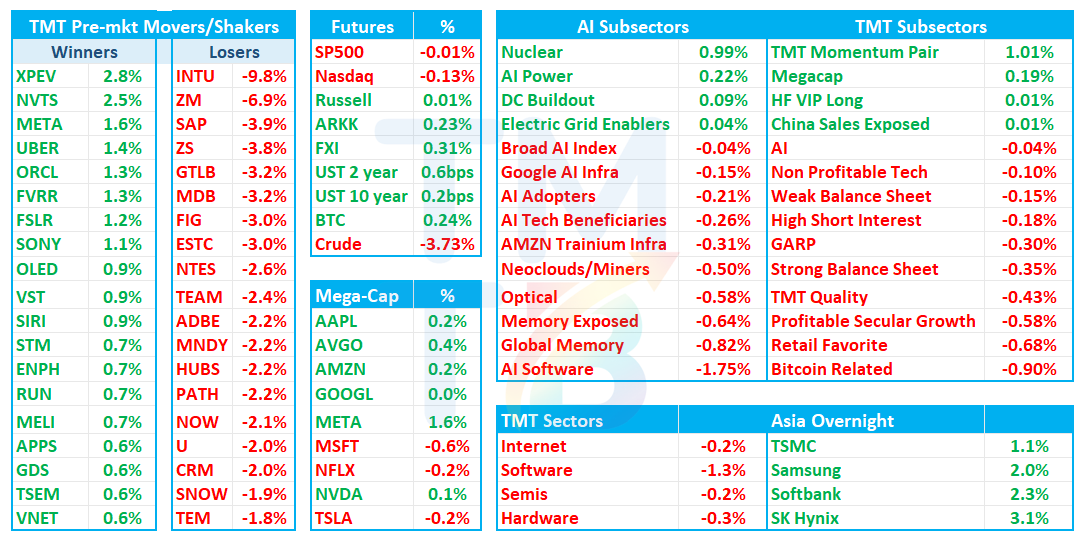
Good morning. Futures slightly down as tech investors have all eyes on NVDA tonight (implied move 5%). Crude -4% while yields are flat following headlines Iranian Foreign Minister as Omani counterpart discussed “interim framework” aimed at helping ships pass through SoH.
Asia mainly up overnight: TPX +0.42%, NKY +0.62%, Hang Seng +0.56%, HSCEI +1.05%, SHCOMP +0.59%, Shenzhen +0.5%, Taiwan TAIEX +1.47%, Korea KOSPI +0.97%. Softbank +2%; Hynix +3%; Samsung +2%
In the US, TMT Mo +1% while Software -1% leading the way lower after INTU’s lowered topline guide fed into bear fears. ZM -7% was also mixed while SMTC +5% the bright spot on a nice DC driven beat and raise. We’ll cover those first, then move onto the usual.
Let’s get straight to it…
EARNINGS
INTU: Clean Q4, but a deeper-than-feared TurboTax reset and no reacceleration timeline leave the stock narrative in “show me” mode and keeps bears in control
FQ4 revenue, EPS and margins came in above Street, but FY27 revenue and especially TurboTax guidance were materially below expectations as INTU lowers DIY pricing and reinvests to rebuild the low-end customer funnel. Lots of fuel for bears: INTU formally acknowledged that customer acquisition is weak in both major franchises, identified price as the leading reason for TurboTax churn, reduced its medium-term growth frameworks and declined to provide a timetable for reacceleration. Add on AI disintermediation fears, a somewhat aggressive segment guide, and mgmt credibility taking another hit and this was a better day for bears. Wasn’t a favored long going in, now a less favored long leaving despite stock being cheap as these #s should help continue the INTU re-rate from premium compounder to a low-multiple secularly challenged stock. We’ll see how stock trades today — other “AI pressured” names have bounced decently after misses
FQ4 #s
Revenue: $4.354B, +13.7% y/y (last q +10.4% y/y) vs. Street $4.273B, +11.5%
EPS: $4.03, +46.5% y/y vs. Street $3.58
Non-GAAP OM: 33.3% vs. Street 30.7%
FQ1’27 Guidance
Revenue Guide: $4.294–4.313B, midpoint $4.304B, +10.8% y/y vs. Street $4.373B, +12.5%
Non-GAAP EPS Guide: $2.44–2.48, midpoint $2.46, +30–33% y/y on the recast SBC-inclusive basis. The legacy ex-SBC equivalent is $3.92–3.96 vs. Street $4.04.
FY27 revenue was guided to $23.279–23.512B, midpoint $23.396B, +9.1% y/y vs. Street $23.822B, +11.5%, while TurboTax growth of 2–3% was well below Street at 6.8% and below the roughly 3–4% investor expectation cited in the materials.
Non-GAAP Operating Income Guide: $902–915M, midpoint $909M, with 21.0–21.2% OM under the new definition. The legacy Street comparison was $1.480B and 33.8%; after adjusting Street for SBC, the guide is approximately 3% below Street.
The reset reflects weak new-customer formation, with online paying customers up only 3%, and lost DIY tax customers as price became the No. 1 reason for churn. INTU is deliberately sacrificing initial ARPC to rebuild volume and monetize customers later through assisted tax, Credit Karma and platform services.
The positives bulls will try to hang on to: Assisted Tax, Money and Mid-Market collectively grew 34% and reached 30% of revenue, Q4 profitability and cash flow were strong, and the FY27 profit guide was above Street after adjusting for the new treatment of SBC.
Key Takeaways:
Reset. This was a genuine resetting of the growth algorithm rather than a routine conservative guide. FY27 revenue growth falls to 9–10% from 14% in FY26; GBS is guided to 13–14%; TurboTax falls to 2–3%; and the three-year frameworks were reduced to 10–15% for GBS from 15–20% previously and 4–8% for Consumer from 6–10%. The central question is no longer whether INTU can sustain mid-teens growth through price, mix and upsell. It is whether INTU can restart volume growth without creating a lasting ARPC and margin problem.
Tax. Price is now the leading reason customers leave TurboTax, and INTU acknowledged losing quality DIY customers to lower-cost providers. FY27 TurboTax growth of 2–3% compares with Street at 6.8% and an investor expectation of roughly 3–4%. TurboTax Live is expected to slow to the mid-teens from 37% in FY26, below the 20%+ investor bogey cited in the materials, because more than three-quarters of FY26 Live additions came from upgrades out of the existing DIY base rather than direct competitive takeaways. Mgmt did not quantify the DIY ARPC decline
Economics. The strategic argument is that lower DIY pricing should not be judged solely on tax revenue. Customers using both TurboTax and Credit Karma generate approximately 2x the revenue of single-product customers, while Credit Karma members filing through TurboTax increased more than 50%. DIY also remains the primary feeder into Live. The bull case therefore requires INTU to prove that lower acquisition ARPC produces better lifetime value through assisted tax, financial products and year-round engagement.
Customers. Total online paying customers reached 8.9M, up only 3%, roughly two points slower than FY25; U.S. QBO customers excluding self-employed grew 6%. INTU attributed the slowdown largely to its own prioritization of mid-market, Money and AI platform development over broad-based customer acquisition. QuickBooks Free and Lite are intended to reopen the funnel, with more than 20,000 customers already active or converted to paid offerings and early monetization coming through payments and upgrades.
Timing. Mgmt declined to say whether FY27 is definitively the growth trough or whether reacceleration could slip into FY28. Instead, it asked investors to judge progress quarter by quarter. This is important because the reset does not yet establish a clear earnings inflection date; the FY27 tax season and evidence of improving online customer additions are likely to remain the key proof points.
Mid-market. The upmarket thesis remains intact. FY26 mid-market revenue grew 39%, customers grew 28%, new-to-the-franchise customers grew more than 30%, and Intuit Enterprise Suite annualized revenue exceeded $145M, roughly 4x last year. The caveat is that approximately three-quarters of customer additions came from upgrades or desktop migrations. That proves product-market fit and cross-sell strength, but also highlights why the low-end funnel must be replenished.
AI. AI usage is producing tangible product outcomes: millions of customers are using AI-native experiences, customers are getting paid four days faster and reducing manual work by 30%, and more than 75% of Enterprise Suite customers use AI agents monthly. Mgmt did not characterize AI as the direct cause of the reset and argued that INTU will be the disruptor, not the disrupted. The sell-side interpretation is divided, however. This will feed bears view of low-cost AI-enabled tax alternatives as an emerging share threat, while the callback explicitly attributed TurboTax losses primarily to FreeTaxUSA and lower-end price competition rather than AI.
Money. Money remains one of the cleanest growth engines. Q4 online payment volume grew 32% including Bill Pay and 21% excluding it, while QuickBooks Capital loan volume increased 54% to $1.9B. Capital revenue will face a yield headwind as INTU sells a larger share of loans to forward-flow partners, but this also reduces balance-sheet risk. Q4 additionally benefited from a one-time launch service for a new partner, so not all of the quarter’s Money momentum should be extrapolated.
Margins. Q4 adjusted OM of 33.3% was 260bps above Street. FY27’s new SBC-inclusive non-GAAP OM is approximately 34.6%; on the legacy ex-SBC basis, guidance implies 43.3% versus Street at 41.8%. The apparent profit upside is therefore real, but definition changes make headline comparisons noisy. Workforce savings and efficiency gains are funding increased sales, marketing and product investment, and mgmt continues to target company-level margin expansion and at least high-teens annual EPS growth.
Mailchimp. Mailchimp revenue declined slightly in Q4 and is guided flat to down 1% in FY27, with higher effective pricing offset by churn. It will become a separate reportable segment, improving visibility but also separating a structurally weak asset from the healthier GBS franchise. Mgmt said it is focused on maximizing Mailchimp’s value and profitability, although no divestiture or other strategic action was announced.
Capital. Q4 operating cash flow was $1.331B versus Street at roughly $624M. INTU repurchased $2.1B of stock in Q4 and $5.5B in FY26, reducing weighted-average diluted shares by 2%; $7.9B remained authorized. Cash and investments were $7.2B against $7.7B of debt, and INTU issued $1.75B of senior notes to address FY27 maturities. Buybacks are expected to remain a significant part of the EPS algorithm.
Callback. The most important callback message was that both funnel problems were viewed as correctable execution issues. In QuickBooks, INTU said it overemphasized mid-market, Money and AI investments and underemphasized the broader customer base. In tax, the company identified FreeTaxUSA and low-end pricing, rather than AI disruption, as the primary source of losses. That supports the “self-help reset” thesis, but it also confirms that the weakness was not merely conservative guidance.
Bull vs. Bear Debate
The broader bull thesis is that INTU still owns two highly valuable financial operating systems with brand, data and distribution advantages that lower-priced point solutions cannot easily replicate. QuickBooks sits inside core accounting, payroll, payments, bill pay, capital and workforce workflows, while TurboTax and Credit Karma give INTU both a tax-acquisition funnel and year-round consumer monetization engine. Proprietary financial data, the accountant network and regulated-domain expertise should make AI more valuable inside INTU’s platform than in a standalone generic application. Early product evidence supports that view: millions are using AI-native experiences, Enterprise Suite agent adoption exceeds 75%, and Accountant Suite already has more than 150,000 accountants on the platform.
This quarter also showed that the strategic growth assets are not broken. Assisted Tax, Money and Mid-Market grew 34% collectively; mid-market revenue grew 39%; online Money grew 31%; Enterprise Suite annualized revenue exceeded $145M; and Credit Karma grew 16.5% in Q4. These businesses provide multiple paths to offset lower entry pricing through services attach, mix and lifetime value. The reset may also prove conservative. TurboTax’s 2–3% guide is well below Street, Live drops from 37% to the mid-teens, and FY27 total growth is being set below 10% despite INTU not having grown below 10% since FY15. The Q4 margin and cash-flow results, coupled with an ex-SBC FY27 profit guide above Street, show that INTU retains meaningful expense and capital-return levers while it fixes customer acquisition.
Valuation is the other major bull argument. 12x one FY28 SBC-inclusive EPS estimate, an unusually low valuation for a company still targeting high-teens EPS growth. A modest stabilization in DIY units or an improvement in QBO customer growth could therefore produce both estimate upgrades and multiple expansion. The key catalysts are evidence that QuickBooks Free and Lite are adding incremental customers, better-than-guided tax volumes and a successful conversion from lower entry ARPC into payments, Live and Credit Karma monetization.
The bear thesis is that INTU’s low-end weakness is not merely a temporary allocation mistake. Online paying customer growth has decelerated to 3%, U.S. TurboTax units declined 2%, and price has become the main reason for tax churn. Low-cost and potentially AI-native products are reducing the value consumers place on traditional DIY software, while QuickBooks faces increasingly capable alternatives aimed at new and very small businesses. Lowering entry prices may stabilize volume, but it also risks exposing that prior revenue growth depended too heavily on pricing and upsell rather than durable customer expansion.
The Live story also looks less proven than bulls believed. More than three-quarters of FY26 Live additions came from converting existing DIY customers, and Live growth is now expected to slow from 37% to the mid-teens. That suggests INTU has been better at moving its own customers upmarket than taking meaningful share directly from tax professionals and stores. If DIY volumes continue shrinking, the future pool of customers available for Live conversion also shrinks. The TurboTax and Credit Karma lifetime-value argument is economically compelling, but it has not yet demonstrated that lower tax ARPC will create enough incremental engagement to offset the immediate revenue loss.
GBS has a similar funnel issue. Mid-market growth remains strong, but approximately three-quarters of additions came from upgrades or desktop migrations, total online customers grew only 3%, and Desktop represents nearly a quarter of GBS while entering structural decline. Mailchimp is flat to down, Capital is shifting toward lower-yield partner-funded loans, and mgmt would not commit to reacceleration by FY28. In that scenario, buybacks and SBC leverage may preserve EPS growth for a period, but investors could view the earnings algorithm as increasingly financial rather than operating and keep the multiple compressed.