


Good afternoon. It was a good day in Tech land as QQQs rallied close to 3%, with plenty of green on the screen across all sectors. META +12% (2nd largest non EPS move) and CPUs (ARM +17%; INTC +12%; AMD +10%; QCOM +10%) were the standouts today as investors increasingly connected consumer agentic harnesses like MUSE with the next wave of compute demand. AMD joined DELL/HPE among a very select few large cap AI semi stocks hitting ATHs as AMD crossed the $1T marker, which continued to confirm to semis investors that pockets of the AI trade can still work, although obviously many questions today of “too far, too fast?”. It’s been a choppy couple of months, but the “up” part of our “choppy but upwards trending” call is finally playing out (we don’t think we’re completely out of the chop woods yet, however).
As you all have likely already figured out at some point over the past couple of weeks, the key to the consumer agentic theme is that these agents don’t just generate tokens; they run browsers, call tools and execute multistep tasks, which is all CPU driven. This is the next big use case semis investors have been hoping to see as coding ramped throughout the year, with agents now moving beyond developers and into everyday consumer tasks. The CPU read-through isn’t new, but MUSE is making the potential scale a lot more tangible.
Outside of semis, anything tangentially related to this theme caught a bid today: FSLY +15%/AKAM +12% / NET +9% (every agent action is a web request hitting a Cloudflare-fronted site, priced per request. New ATHs here as well). OKTA +5% on the identity/security read-through, as more agents taking action means more identities to authenticate, permissions to manage and access to secure. TWLO +9% on the communications read-through, as agents making calls, sending texts and booking appointments could unlock another wave of usage across its voice and messaging APIs.
Even SHOP +7% got in on the action as Tobi announced they are partnering deeply with Muse on agentic checkout which helped dent the somewhat misguided bear read for SHOP over the last couple weeks.


This goes straight against the bear claim that SHOP Pay has zero value to an agent. It also makes the "Meta routes payments around Shopify" scenario less likely, at least for now.
The negative read-throughs are the names that have been underperforming over the past couple of weeks on the theme: OTAs on the risk agents take over travel discovery and booking; GOOGL +1.5% on potentially fewer traditional searches and monetizable clicks; and AMZN +1.8% on the risk of losing the shopping starting point and associated ad dollars. AMZN blocked MUSE from accessing its storefront today, highlighting the fight over who owns the customer relationship. Platforms like DASH/CART face a similar debate: agents comparing the all-in cost of an order could make consumers less loyal to any one app and force platforms to compete harder on price. The risk isn’t necessarily that consumers stop booking trips or ordering groceries, but that the agent becomes the default destination and pressures the economics of the platforms underneath. It’s still early and #s unlikely to get hit in the near-term, but all of these names now have an uphill battle in convincing Tech investors consumer agents aren’t a real threat. The daily knife fight around UBER, which has been stuck at between $70 and $80 for eons, over whether AVs are an existential threat comes to mind.
AMZN and GOOGL at least have a potential offset through greater CPU/GPU demand on their cloud platforms. There’s also somewhat of a bull case beyond cloud for these two: GOOGL has Gemini plus Search/Chrome/Android distribution to make its own agents the default, rather than simply cede the customer relationship to META or someone else. AMZN has Prime, purchase data and the fulfillment network, plus its own shopping assistant. The bull case is that GOOGL can own the new starting point and AMZN can still win the basket even if the starting point changes. Protecting the transaction and protecting the ad dollars are two different things, though…this debate unlikely to be settled soon.
Kudos to those at pods who put the L/S META/AMZN pair over the last couple weeks.
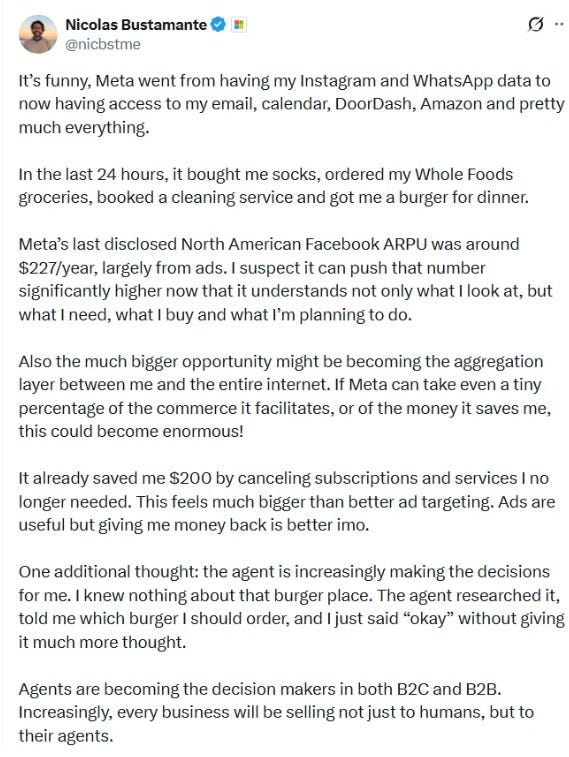
For META, we thought this tweet from a MSFT employee laid out why this can potentially be big for their ad biz:
Ben Thompson from Stratechery had the negative read-through for frontier labs, arguing that MUSE shows a “good enough” model can already power a compelling consumer agent with a real moat. He says unlike coding agents, where your code remains portable, personal agents become harder to replace as they accumulate your information and become embedded in daily life: